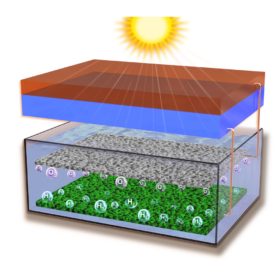
Direct solar hydrogen generation tech powered by 24.3%-efficient tandem perovskite-silicon solar cell
Developed by Australian scientists, the demonstrated system is claimed to achieve a solar-to-hydrogen efficiency of 20% at a levelized cost of hydrogen (LCOH) of $4.10/kg. The direct solar hydrogen generation technology is powered by a tandem perovskite-silicon solar cell with an unprecedented high open-circuit voltage of 1.271 V, and a power conversion efficiency of 24.3%.
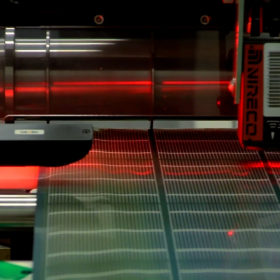
Single crystal perovskite solar cell with 17.8% efficiency
The solar cell was manufactured with crystals that were grown directly onto indium tin oxide (ITO) substrates covered with hole transport layer (HTL). These substrates have a controlled thickness of tens of micrometers and area of tens of mm2. The device showed an efficiency of 17.8%, a short-circuit current of 21.0 mA cm−2, an open-circuit voltage to 1.08 V, and a fill factor to 78.6%.
Inverted perovskite solar cell with 22.1% efficiency via star-shaped polymer
The solar cell was fabricated with a special polymer that is able to passivate defects at the grain boundaries and interfacial surfaces, inhibit nonradiative recombination and charge-transport loss, and improve stabilities under moisture. The device exhibited a remarkable fill factor, of 0.862.

CEA-Ines achieves 19.2% efficiency for flexible perovskite solar cell
The cell was fabricated with a flexible substrate made of indium tin oxide (ITO) and polyethylene terephthalate (PET). The device was tested through a damp heat test and showed it can retain around 90% of its initial efficiency after 800 hours.
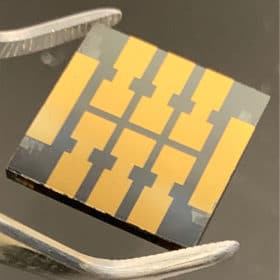
Perovskites stick together for better performance
Scientists in the U.S. demonstrated an additive that acts as a “molecular glue” within a perovskite solar cell. Treating the cells with this self-assembled monolayer material was shown to greatly improve their long-term performance, whilst also providing a boost to conversion efficiency. And the scientists further point out that the treatment relies on simple processing and readily available materials – good signs for its applicability in manufacturing.

A different angle on perovskite defects
Scientists in China took a closer look at the role of defects in limiting the performance of perovskite solar cells, demonstrating a screening effect that could be tuned to make material defects “invisible” to charge carriers, greatly improving cell performance. Using this approach they demonstrate a 22% efficient inverted perovskite solar cell, and theorize several new pathways to even higher performance.
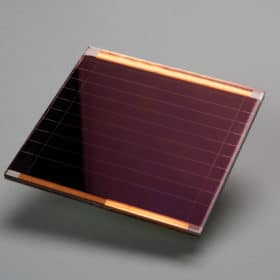
UNIST, EPFL claim 25.6% efficiency world record for perovskite solar cell
Scientists have set a new efficiency record for a single-junction perovskite solar cell at 25.6%. The cell additionally showed operational stability for 450 hours, and intense electroluminescence with external quantum efficiencies of more than 10%.
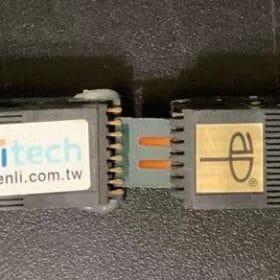
18.3%-efficient perovskite solar cell for automatic light adjustment
Chinese scientists have powered two electrochromic devices with a perovskite solar cell based on a hole transporting material made of poly(triarylamine) (PTAA). The cell has an open-circuit voltage of 1.02 V, a short-circuit current of 22.8 mA/cm2, and a fill factor of 78.4%. When solar radiation is higher, the cells drive the electrochromic devices into a dark state, which in turn reduces the light that can enter a building.
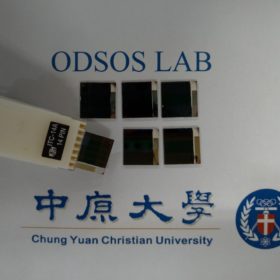
Polyelectrolyte-based inverted perovskite solar cell with 20.29% efficiency
Taiwanese researchers have added bathocuproine (BCP) molecules to three different kinds of solvents used in perovskite cells and have ascertained how this combination increases the carrier mobility and passivates the electron-poor defects. Furthermore, they utilized a polyelectrolyte (P3CT-Na) thin film as hole transporting material instead of commonly-used thin films based on PEDOT:PSS.

Flexible perovskite quantum dot solar cell with 15.1% efficiency
An international research team has developed a PV cell with all-inorganic cesium-lead iodide (CsPbI3) perovskite. The scientists added phenyl-C61-butyric acid methyl ester (PCBM), one of the best electron acceptors in organic PV cells, into the CsPbI3 quantum dot layer.
