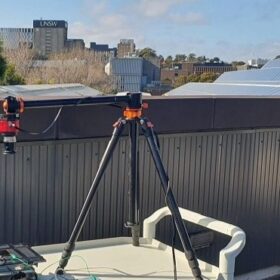
Using photoluminescence, implied open-circuit voltage imaging for perovskite solar cell field testing
To evaluate the outdoor performance and stability of perovskite solar cells using contactless and noninvasive methods, an Australian and Chinese research team found a way to use photoluminescence imaging as well as demonstrating a proof of concept for implied open-circuit voltage (iVOC) imaging. Their research relied on cost-effective equipment that operates under direct sunlight.
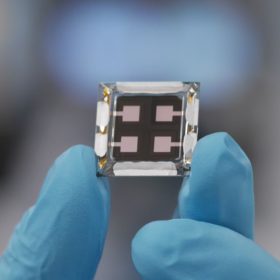
Four-year outdoor testing shows perovskite solar cells suffer from high seasonality
Testing conducted by the Helmholtz-Zentrum Berlin (HZB) in Germany has shown that perovskite solar cells operating at high latitudes in Europe may suffer from higher performance losses in winter compared to conventional PV devices. The scientists warned, however, that at lower latitudes this seasonality may be less pronounced.
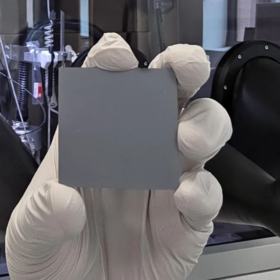
UK researchers developing new type of cadmium telluride PV panels for space applications
A team of UK researchers is working on lightweight cadmium telluride (CdTe) solar devices for space arrays. The aim is to develop 20%-efficient ultra-thin devices to provide lightweight, compact, lower cost solar power for satellites and space-based manufacturing applications.
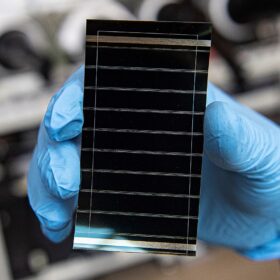
Bottom-up cost model for perovskite solar module manufacturing
Scientists in Switzerland have conducted techno-economic analysis of perovskite solar module manufacturing costs in terms of levelized cost of energy and have found that these products could be competitive in the Alpine country provided that they achieve an efficiency of over 24% with a lifespan of 20 years and over 20% with a lifecycle of 30 years.

Perovskite solar cell testing in underwater environments shows surprising efficiency results
Researchers in Italy have tested how perovskite solar cells could perform underwater and have found that, at very shallow depths, they may even achieve a higher power conversion efficiencies compared to reference devices operating under out-of-water conditions.

CNNP Optoelectronics unveils 16.5%-efficient perovskite solar module
CNNP Optoelectronics has started producing a 1,200 mm × 1,600 mm perovskite solar module on a 200 MW pilot line, marking a step toward scaling commercial manufacturing of next-generation PV technologies.
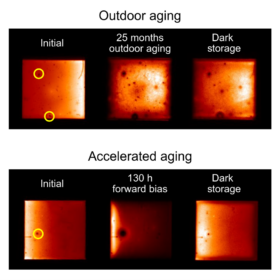
New accelerated aging test for perovskite solar cells
To assess ion migration-induced degradation modes via accelerated ageing of perovskite solar cells, an international research team investiagted using electric forward bias and dark storage approach.
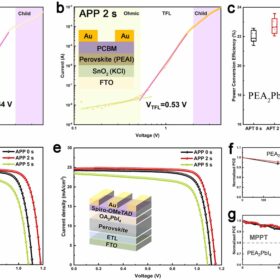
Perovskite solar cell built through Argon plasma treatment achieves 23.55% efficiency
Researchers in China have used an argon plasma polishing pre-treatment (APP) to remove surface defects and increase passivation effectiveness in perovskite solar cells. The result is a perovskite device with a 2D interface that significantly improves stability and performance.

Scientists build 29.5%-efficiency all-perovskite tandem solar cells through universal interfacial engineering
An international team of researchers used a novel interfacial treatment to improve the performance of perovskite solar cells across a range of narrow and wide bandgap single junction, tandem, and mini-module samples. An all-perovskite tandem solar cell demonstrated its use with a certified efficiency of 29.5%.
Indian scientists build 29.14%-efficient tandem solar cell with inverted top perovskite device
The researchers said they optimized the low-bandgap inverted perovskite cells through a passivating aluminum oxide (Al2O3) interlayer deposited via atomic layer deposition (ALD), which significantly helped improve device efficiency.
