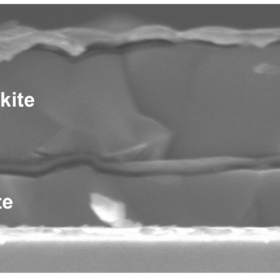
All-perovskite tandem solar cell based on tin-lead perovskite achieves 27.8% efficiency
Scientists in the United States have fabricated an all-perovskite tandem solar cell that reportedly shows reduced interfacial energy loss in the cell’s top device. It was built with a hole transport layer based on a compound known as P3CT that was doped with lead iodide.
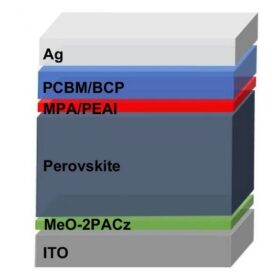
Inverted perovskite solar cell based on synergistic bimolecular interlayer achieves 25.53% efficiency
Developed by researchers in China, the inverted perovskite device purportedly achieves the smallest nonradiative recombination-induced open-circuit voltage loss reported to date. It uses a synergistic bimolecular interlayer to functionalize the perovskite interface.

Solar cell based on high-entropy hybrid perovskite achieves 25.7% efficiency
Researchers in China have built for the first time an inverted perovskite solar cell relying on a high-entropy hybrid perovskite material. The result is a device with an improved open-circuit voltage and fill factor, due to reduced non-radiative recombinations and optimized interface.
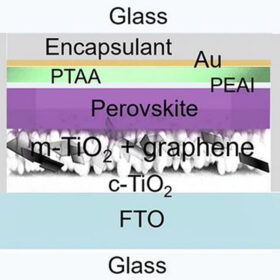
New encapsulant for perovskite solar cells, modules withstands multiple accelerated ageing tests
Researchers in Italy have developed a low temperature a blanket-cover encapsulation technique that reportedly improves the stability of perovskite PV devices. They said the new technique reduces thermomechanical stresses caused by both the encapsulation process and the temperature gradients occurring during accelerated ageing stresses.
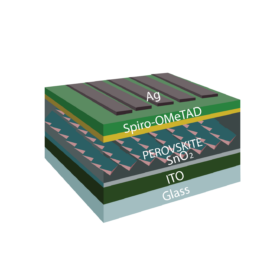
Perovskite solar cell based on electron-rich surface passivation layer achieves 23.27% efficiency
Chinese in China have utilized two sulfone-based organic molecules known as diphenylsulfone (DPS) and 4,4′-dimethyldiphenylsulfone (DMPS) to passivate absorber defects in perovskite solar cells. The result is a device with a higher electron cloud density at the interface between the perovskite material and the passivation layer.
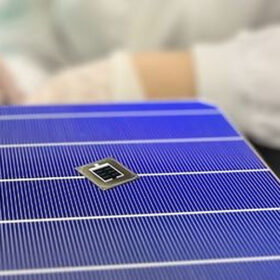
KAUST builds perovskite-perovskite-silicon tandem solar cell with 31.5% efficiency
The Saudi research institute said its new four-terminal tandem device has achieved the highest efficiency ever reported for perovskite-based 4-T and triple-junction tandem solar cells to date. The key feature of the cell is the hole transport layer of the top perovskite cell, which was engineered with self-assembled monolayers.

Researchers discover method to help perovskite solar cells self-heal
A global team of researchers – lead by Monash University in Melbourne, Australia – says it has made a breakthrough that could make perovskite solar cells more reliable and efficient.
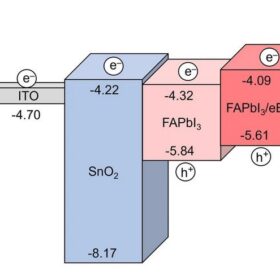
Carbon-based perovskite solar cell relying on phosphorene achieves 15.58% efficiency
The result is the best efficiency ever recorded for a carbon-based PV cell using unconventional hole transporting materials to date. The device was built with a hole transparent layer based on electrochemically produced large-area phosphorene flakes, which reportedly enable the required band energy alignment within the cell.

Carbon electrode-based perovskite solar cell achieves 20.8% efficiency via new lamination tech
A research team in Australia has used a lamination technique known as cold isostatic pressing (CIP) to build a perovksite solar cell based on a flexible bilayer electrode made of carbon and silver that can reportedly compete with gold-carbon eletrode based counterparts in terms of efficiency and stability.

Perovskite solar cell modified with potassium trifluoromethanesulfonate achieves 23.96% efficiency
A Chinese research team has modified the absorber of a conventional perovskite solar cell with potassium trifluoromethanesulfonate (KTFS) and found that the additive improved the device performance and stability. The cell’s perovskite film reportedly showed less lead defects and lower J-V hysteresis.
