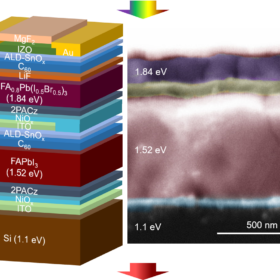
Triple-junction perovskite–perovskite–silicon solar cell achieves record-breaking efficiency of 24.4%
Developed by scientists in Germany, the triple-junction cell is based on a perovskite top cell with an energy bandgap of 1.84 eV, a perovskite middle cell with bandgap of 1.52 eV, and a silicon bottom cell with a bandgap of 1.1 eV. The device achieved an open-circuit voltage of 2.84 V, a short-circuit current of 11.6 mA cm–2, and a fill factor of 74%.
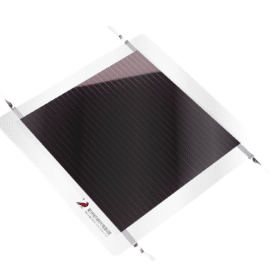
New research sheds light on results achieved by major perovskite solar manufacturers
A team of researchers from China and the United States has summarized the commercialization status of several manufacturers, including Saule Technologies, Solaronix, Panasonic, Toshiba, Utmolight, Wonder Solar, Kunshan GCL, and Microquanta.
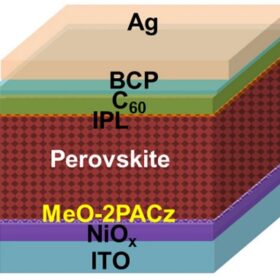
Methylammonium-free inverted perovskite solar cell achieves 23.17% efficiency
Scientists in Japan have fabricated an inverted pervoskite cell with a new bond/charge regulated defect passivation technique consisting of introducing bifunctional molecules onto the perovskite absorber. The device exhibited a low open circuit voltage deficit and remarkable stability.
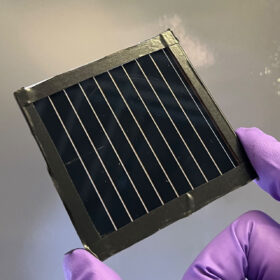
Scientists claim 21.1% efficiency for perovskite solar module built with liquid crystals additives
An international team of researchers used large-area perovskite films treated with liquid crystals additives to make photovoltaic modules with a certified stabilized efficiency of 21.1% at an aperture area of 31 cm2.
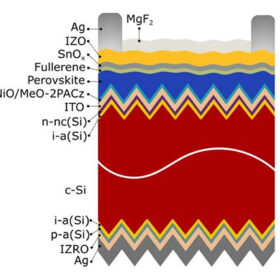
Perovskite-silicon tandem solar cell with sublimed C60 source material achieves 30.9% efficiency
The result was certified by Fraunhofer ISE CalLab. The cell uses a top inverted PV device using an electron transport layer made of thermally evaporated buckminsterfullerene (C60) with minimized parasitic optical absorption.
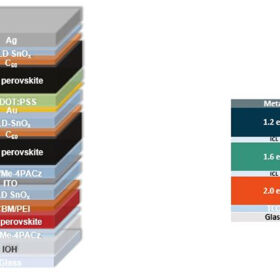
All-perovskite triple-junction solar cell achieves 25.1% efficiency via new passivation technique
An international research team built the triple-junction device with dual bulk and interface passivation technique aimed at promoting halide homogeneity at the interface between the perovskite absorber and the hole-transport-layer. The 0.049 cm2 cell achieved a remarkable open-circuit voltage of 3.33 V and was also able to retain 80% of its initial efficiency after 200 h of continuous maximum power point tracking.
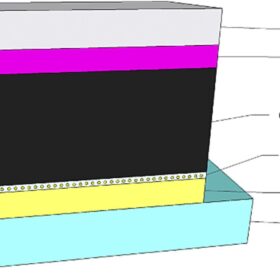
Improving perovskite solar cell performance with silver nanoparticles
Scientists in the United Kingdom have proposed for the first time to deposit silver nanoparticles in electron transport layers used in perovskite solar cells to improve device performance. They found that an “optimal” concentration of silver nanoparticles may help to improve a perovskite cell’s charge transfer and extraction, as well as its efficiency.
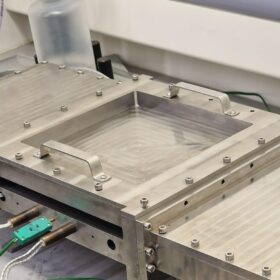
Aerosol process to boost perovskite solar cell performance
Aerosolar, a spinoff from the Queen Mary University of London, has created a novel aerosol method that it claims boosts efficiency and stability of metal halide perovskite solar cells.
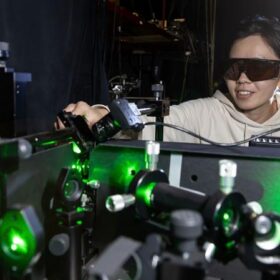
‘Shallow defects’ key to high efficiency of perovskite solar cells, say researchers
Researchers at the Jülich Research Center in Germany have used novel photoluminescence measurements to analyze the recombination of charge carriers in perovskite solar cells. They have found that the loss of charge carriers in perovskite devices works differently from other types of PV cells.
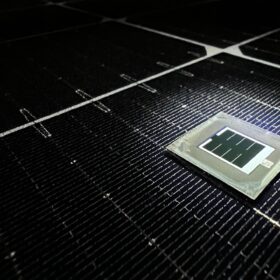
Perovskite-silicon tandem solar modules must ensure degradation rate of 0.4%/year to compete with crystalline silicon
Researchers from Saudi Arabia’s King Abdullah University of Science and Technology (KAUST) investigated the commercial prospects of perovskite-silicon tandem PV technologies and found that, in order to bring them closer to market maturity, their cost should not exceed by 30% that of crystalline silicon counterparts. Their roadmap stresses the importance of reducing perovskite degradation and improving product stability.
