
Scientists achieve 25.4% efficiency in perovskite solar cells with enhanced stability using multivalent ligands
Researchers have used multivalent amidinium ligands to boost perovskite solar cell efficiency to 25.4%, achieving over 95% stability after 1,100 hours at 85 C. The proposed approach enables controlled low-dimensional passivation layers, offering a practical route for durable, large-area perovskite devices.
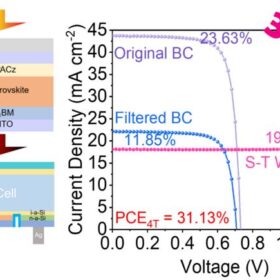
Chinese scientists build 31.13%-efficient perovskite-silicon tandem solar cell via 2D seeding agent
Researchers in China developed a novel two dimensional (2D) seeding agent to regulate crystallization in a 1.80-eV wide-bandgap perovskite film. A perovskite-silicon tandem device made with the resulting optimized subcell achieved an efficiency of 31.13%, outperforming a control device.

Researchers achieve record perovskite solar module stability under light, heat, and UV stress
An international research team has developed a new two-dimensional perovskite interlayer based on a co-crystal engineering strategy for more robust perovskite films. It demonstrated improved performance in small area perovskite solar cells and, in a 48 cm2 module, contributed to retain 95% of initial efficiency after 5,000 h.
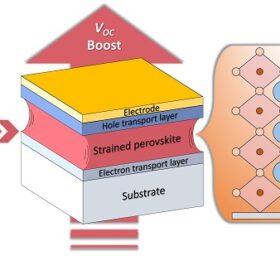
EPFL researchers enhance perovskite solar cell performance via rubidium
Researchers led by Michael Grätzel at the Ecole Polytechnique Federale de Lausanne in Switzerland have recently led efforts to improve perovskite optoelectronic properties using small-radius rubidium ion chemistry to enable more stable and efficient perovskite solar cells.
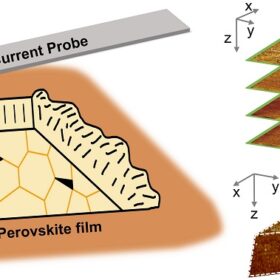
New research sheds light on defect regions in perovskite solar films
A Chinese research group has demonstrated an electrical imaging technique using 3D tomographic conductive atomic force microscopy to investigate passivation strategies of perovskite films to improve stability and efficiency of perovskite solar cells.

Leecell develops organic PV for indoor, outdoor use
The South Korean startup is developing organic solar cell technology made using a proprietary roll-to-roll process. It targets both indoor and outdoor integrated PV applications.

Imaging tech to analyze sub-cells in tandem and triple junction PV devices
A team at Fraunhofer ISE has created new imaging methods to measure losses in individual sub-cells of multi-junction solar cells based on perovskite-silicon and perovskite-perovskite-silicon combinations.

China National Petroleum Corporation achieves 25.05% efficiency for inverted perovskite solar cell
The Chinese energy and oil company said the cell can be used as a top device in perovksite-silicon tandem configurations. The result was confirmed by the Shanghai Institute of Microsystem and Information Technology (SIMIT).
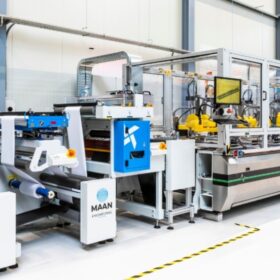
TNO offers mass customization line for integrated PV applications
The Dutch research institute’s highly automated research line offers customized, flexible solar semi-finished PV products to partners developing integrated PV applications.

Panasonic glass-based perovskite solar panels tested in office windows
The Japanese electronics manufacturer is testing its glass-based perovskite solar PV technology in office windows made by YKK AP, a construction and building materials company.
