
All-perovskite tandem PV cell based on carboranes hits 27.2% efficiency
Researchers have developed a thermal regulation strategy to improve the performance of inverted tin-lead perovskite tech for all-perovskite tandem solar cells. It has an efficiency of 23.4% and contributed to a 27.2% efficiency in a tandem cell while ensuring stability.
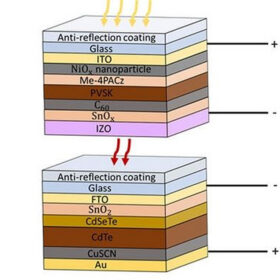
U.S. scientists demonstrate 25%-efficient perovskite-cadmium tandem solar cell
The researchers say the cell has a top perovskite cell with a transparent back contact made of indium zinc oxide and a commercially established cadmium telluride bottom device. They claim the champion tandem cell has the potential to reach a 30% efficiency.
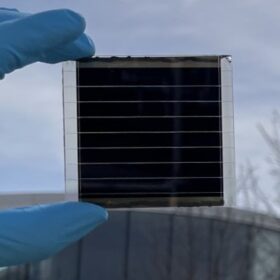
EPFL unveils perovskite solar module with record-breaking efficiency of 23.3%
The solar modules are based on the record-breaking 25.32%-efficient 2D/3D perovskite solar cells that the Ecole Polytechnique Fédérale de Lausanne unveiled in July 2023. The panel has an aperture area of 27.22 cm2, and were encapsulated by glass-glass encapsulation technology combined with an edge seal of the module under UV light illumination.
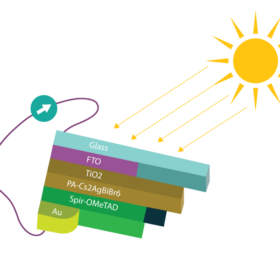
New doping strategy increases lead-free perovskite solar cell efficiency
An international research group has developed a solar cell based on a lead-free perovskite material known as Cs2AgBiBr6. The cell’s absorber was doped with trans-polyacetylene, which reportedly helped the device to improve its efficiency by more than 20%.
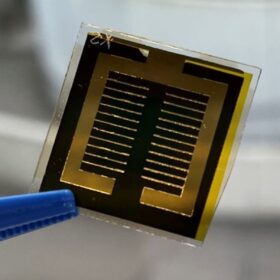
KIT researchers develop18.2%-efficient perovskite solar cell via scalable inkjet process
Researchers at Karlsruhe Institute of Technology (KIT) have developed a scalable two-step evaporation and inkjet process for perovskite thin-film solar cells. The new technique reportedly enables to build champion cells with the same efficiencies as those made with the spin coating process.
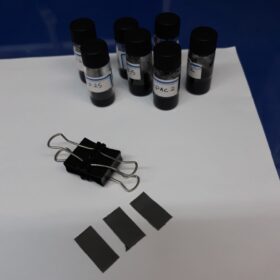
Improving perovskite solar cell performance with conductive adhesive ink
Conceived by researchers from Iran, the new conductive adhesive ink is made of polymethyl methacrylate (PMMA) and is used as an interlayer between the cell’s hole transport layer and carbon foil. It reportedly ensures higher cell stability while also providing remarkable efficiency.
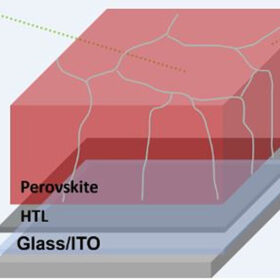
Tin halide perovskite solar cell based on new precursor additive achieves 12.22% efficiency
An international research team has developed a new type of perovskite solar cell by using 4-phenyl thiosemicarbazide (4PTSC) as a precursor additive. The device showed an improved open-circuit voltage and “exceptional” long-term stability.
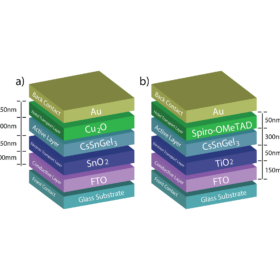
Researchers design tin-germanium-based perovskite solar cell with potential efficiency of 31.49%
Researchers in Malaysia have simulated a mixed cation perovskite solar cell integrating tin and germanium in the absorber. By modulating the perovksite layer thickness, they were able to achieve an efficiency ranging from 24.25 % to 31.49 %
ZSW, First Solar partner to collaborate on thin-film PV
Zentrum für Sonnenenergie- und Wasserstoff-Forschung Baden-Württemberg (ZSW) and First Solar have agreed to work together to develop thin-film PV technologies on a gigawatt scale.
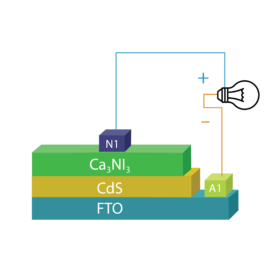
Researchers design 31%-efficient perovskite solar cell based on calcium nitrogen iodide
An international team has demonstrated a perovskite solar cell relying on inorganic calcium nitrogen iodide (Ca3NI3) perovskite and has found this absorber material offers advantages such as tunable bandgap and resistance to heat. The device achieved a fill factor of 81.68%.
