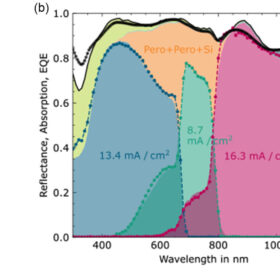
Perovskite-perovskite-silicon triple-junction solar cells have technical potential to reach 44.3% efficiency
A German research team has investigated the optical properties of perovskite/perovskite/silicon triple-junction cells and has found these devices may have a practical efficiency potential of 44.3% assuming idealized electrical parameters. These cells may also potentially achieve a fill factor of 90.1%.
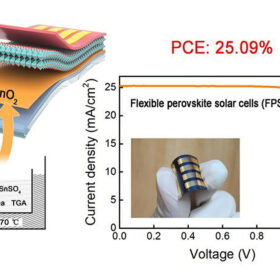
Flexible perovksite solar cell with tin oxide electron transport layer achieves 25.09% efficiency
Researchers in China have developed a new chemical bath deposition technique to deposit tin oxide on a perovskite cell’s flexible substrate without requiring a strong acid. The resulting cell has achieved a certified efficiency of 24.90% and remarkable stability.
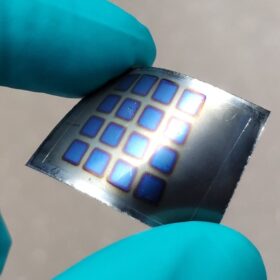
Perovskite-CIGS tandem solar cell based on fexible steel substrate achieves record-breaking efficiency of 18.1%
Scientists in Australia claim to have achieved the highest efficiency ever reported to date for a perovskite-CIGS tandem solar cell built on a flexible steel substrate. In the proposed cell configuration, steel can act as both a substrate and an electrode.

Perovskite solar cell based on ‘multifunctional’ hole transporting material achieves 26.41% efficiency
Researchers in China claim to have achieved the highest efficiency ever reported for perovskite solar cells based on “alternative” hole transport materials. The device reportedly offers improved hole extraction and significantly reduced charge recombination at the interface between the perovskite layer and the hole transport layer.
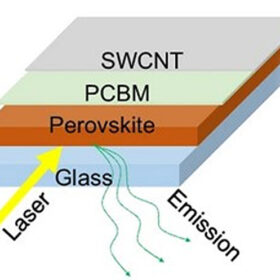
Bifacial PV cell based on single-walled carbon nanotubes achieves 17.1% efficiency
Conceived to be produced at substantially lower costs than conventional perovskite solar cells based on metal contacts, the new cell is reportedly able to achieve a bifaciality factor of over 80% and a power generation density exceeding 36%.
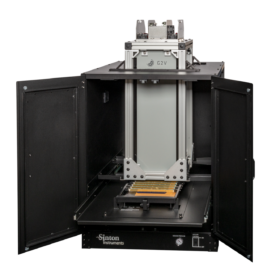
Solar simulator for perovskite-silicon tandem PV cells, modules
A new measurment and solar simulator instrument designed for perovskite-silicon tandem cells and encapsulated mini-modules is the latest product from a collaboration between Canadian solar simulator supplier G2V Optics and U.S.-based measurement instrumentation company Sinton Instruments.

Perovskite thin film: Out with the old, in with the new
Silicon-perovskite tandem solar requires optimization of both approaches, and embodies the weaknesses of each. Meanwhile, the use of pure thin-film devices offers a cheaper, simpler, and more sustainable PV solution for the United States.
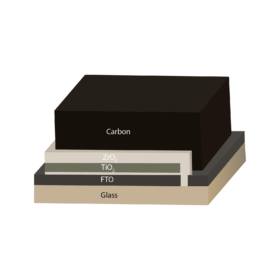
First attempt to build perovskite solar cell based on ionic liquids delivers 13.8% efficiency
North Korean researchers have designed a perovskite solar cell with an absorber treated with ionic liquids. The device reportedly offers improved passivation and fewer recombination losses.
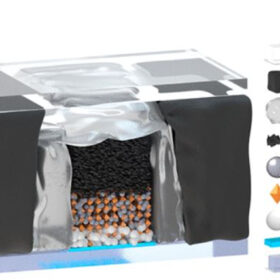
New tech to remanufacture recycled perovskite solar cells
An international research team has developed a novel way to remanufacture fully encapsulated perovskite solar cells after recycling. The researchers say the devices can achieve 88% of the original efficiency of the products.

MIT research provides roadmap to perovskite passivation
Research teams have developed methods for perovskite passivation, but there hasn’t been a clear understanding of how the process works. A new Massachusetts Institute of Technology (MIT) study provides details on how to passivate the material’s surface so the perovskite no longer degrades so rapidly or loses efficiency.
