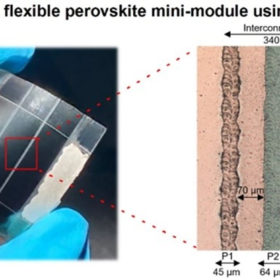
Four-terminal flexible perovskite-CIGS tandem mini-module with 18.4% efficiency
Swiss scientists have built a 4T tandem perovskite/CIGS mini-panel with a geometric fill factor of over 93%. It combines a 10.8%-efficient mini perovskite module and a 15.1%-efficient CIGS device.
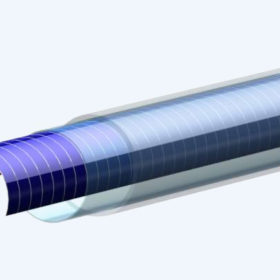
ZSW, Tubesolar achieve 14% efficiency for thin-film agrivoltaic solar tubes
TubeSolar and the Centre for Solar Energy and Hydrogen Research Baden-Württemberg have achieved a power conversion efficiency of 14% for a photovoltaic film based on perovskite.
Eco-friendly solvent for a 16.7% perovskite solar cell
Scientists in Germany looked to eliminate the use of toxic solvents in the production of perovskite solar cells, replacing them with a more environmentally material called dimethyl sulfoxide (DMSO) which has so far proved difficult to integrate into processes suitable for large-scale production. The group demonstrated a scalable blade coating process using DMSO as the only solvent, and reached cell efficiencies close to those achieved using more toxic substances.
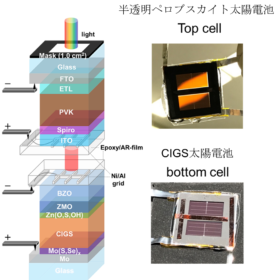
Four-terminal tandem perovskite/CIGS solar cell with 26.2% efficiency
Japanese scientists have developed a tandem device with a 19.5%-efficient perovskite top cell. They claim to have created a semi-transparent perovskite solar cell while maintaining high performance.
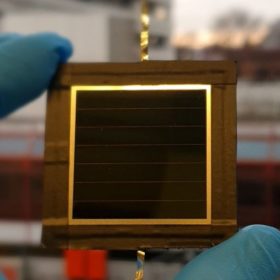
All-perovskite tandem solar panel with 19.1% efficiency
German scientists have developed a two-terminal, all-perovskite solar panel with laser scribing and module interconnections. It has a fill factor of 75%.

CSEM, EPFL achieve 31.25% efficiency for tandem perovskite-silicon solar cell
The new world record was independently certified by the National Renewable Energy Laboratory (NREL) in the United States.
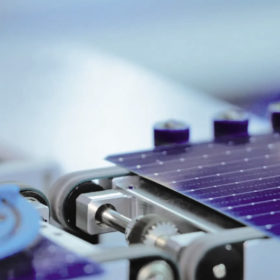
Perovskite-silicon tandem solar cell with TOPCon structure hits 27.6% efficiency
A research group led by Chinese manufacturer JinkoSolar has developed a tandem perovskite-silicon cell with a subcell based on TOPCon tech. The group succeeded in reducing voltage losses in the silicon sub-cell by minimizing the shunting probability during device fabrication.
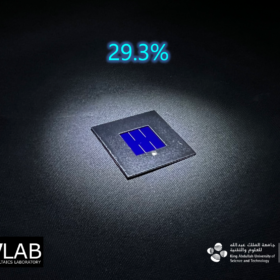
Inverted perovskite-silicon tandem solar cell with 29.3% efficiency
Researchers in Saudi Arabia have built an inverted perovskite-silicon tandem device with a 1 nm thick interlayer based on magnesium fluoride (MgFx). They claim it can stop voltage losses and increase power conversion efficiency, while retaining 95.4% of its initial efficiency after 1,000 hours.
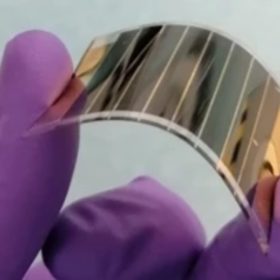
CEA-INES develops 18.95%-efficient flexible perovskite solar panels
French researchers have developed PV modules with an area of 11.6 square centimeters for indoor applications. They said the achieved efficiency level marks a world record for a flexible perovskite device larger than 10 square centimeters.
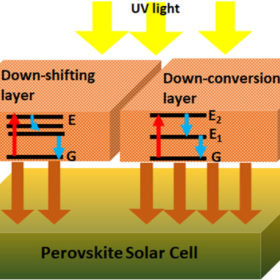
Perovskite solar cells based on down-conversion materials
An international research group has assessed the potential of down-conversion materials to overcome the poor blue response of solar cells. They analyzed how such materials could be used to improve the performance of perovskite-based devices and found that certain advances might be achieved.
