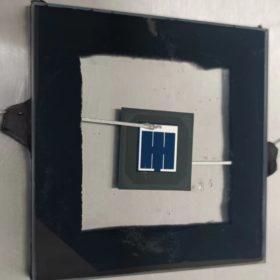
Perovskite-silicon tandem single-cell solar module with 26.2% efficiency
Researchers in Saudi Arabia claim to have reduced cell-to-module losses in tandem perovskite silicon photovoltaic devices through an optical redesign of the module through refractive-index engineering. They built a monolithic perovskite-silicon tandem mini-module with a power conversion efficiency of 26.2%.
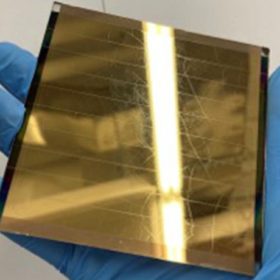
Light-scattering structures to boost solar performance
An international team of scientists developed a nanoparticle structure which, when added to a solar cell, was shown to scatter light and potentially reflect it many times within the cell, contributing to a noticeable jump in current.
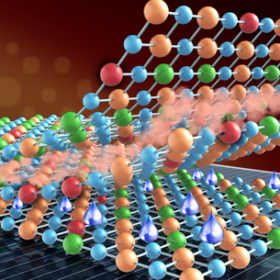
Surface engineering for an 18.6% efficient large-area inverted perovskite solar cell
Scientists in China worked with nickel-oxide as a charge transport layer in a perovskite solar cell, and were able to overcome several of the performance challenges associated with this material through careful surface engineering. Using this approach, the group fabricated an inverted perovskite solar cell measuring 156×156 mm that achieved 18.6% efficiency, along with ‘remarkable’ stability, according to its designers.
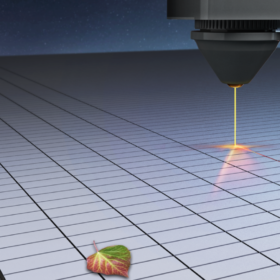
Reverse bias – a hidden challenge for perovskite solar cell stability
New research from renowned PV scientist Martin Green and colleagues at UNSW reveals that perovskite solar cells may struggle to deal with reverse-bias caused by uneven shading or other issues likely to appear in the field. Both the reverse-bias itself and resulting build up of heat can cause several of the materials commonly used in perovskite solar cells to degrade, and these issues have received only limited attention in research published to date. Solutions, however, are at hand.

Perovskite solar cell defect characterization during manufacture for improved stability
A novel electrochemical robotic arm is under development at the University of Arizona to identify perovskite defects during manufacturing rather than after to improve durability.
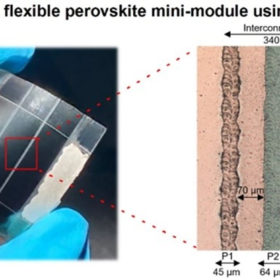
Four-terminal flexible perovskite-CIGS tandem mini-module with 18.4% efficiency
Swiss scientists have built a 4T tandem perovskite/CIGS mini-panel with a geometric fill factor of over 93%. It combines a 10.8%-efficient mini perovskite module and a 15.1%-efficient CIGS device.
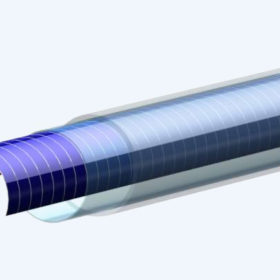
ZSW, Tubesolar achieve 14% efficiency for thin-film agrivoltaic solar tubes
TubeSolar and the Centre for Solar Energy and Hydrogen Research Baden-Württemberg have achieved a power conversion efficiency of 14% for a photovoltaic film based on perovskite.
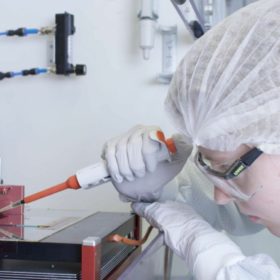
Eco-friendly solvent for a 16.7% perovskite solar cell
Scientists in Germany looked to eliminate the use of toxic solvents in the production of perovskite solar cells, replacing them with a more environmentally material called dimethyl sulfoxide (DMSO) which has so far proved difficult to integrate into processes suitable for large-scale production. The group demonstrated a scalable blade coating process using DMSO as the only solvent, and reached cell efficiencies close to those achieved using more toxic substances.
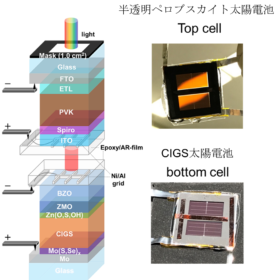
Four-terminal tandem perovskite/CIGS solar cell with 26.2% efficiency
Japanese scientists have developed a tandem device with a 19.5%-efficient perovskite top cell. They claim to have created a semi-transparent perovskite solar cell while maintaining high performance.
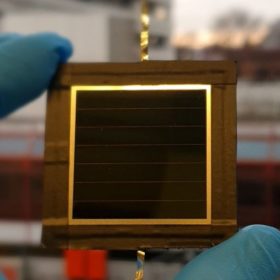
All-perovskite tandem solar panel with 19.1% efficiency
German scientists have developed a two-terminal, all-perovskite solar panel with laser scribing and module interconnections. It has a fill factor of 75%.
