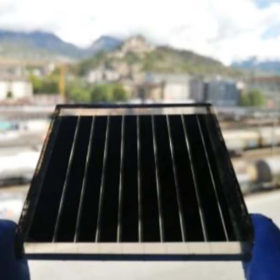
Isomer passivation for a 21.4% efficient perovskite module
An international team of scientists trialled a new approach to passivating defects in perovskite solar cells. Using a tailored arrangement of atoms, the team was able to overcome challenges related to the formation of a two-dimensional perovskite layer on top of the active cell material, and reach 21.4% conversion efficiency for a 26cm² active area, which they claim as a record for a perovskite device of this size.
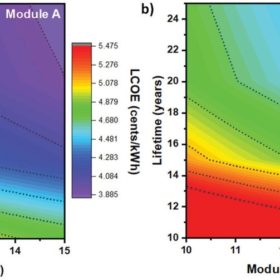
Analyzing the opportunity for perovskite solar module production in India
Scientists in India conducted a techno-economic analysis for a 100 MW production line for carbon-electrode perovskite solar modules, located in Himachal Pradesh, India. The analysis concludes that, even at the smaller scale, this emerging technology could achieve cost levels comparable with today’s silicon solar products.
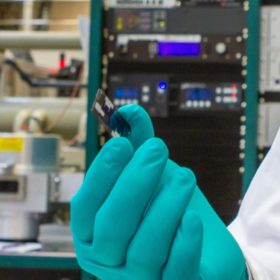
Solliance hits 29.2% efficiency on perovskite/silicon tandem solar cell
The Solliance consortium has built a solar cell in a four-terminal tandem configuration that combines a 17.8%-efficient highly near-infrared transparent perovskite cell with a prototype of an 11.4%-efficient c-Si interdigitated back contact silicon heterojunction cell developed by Panasonic.
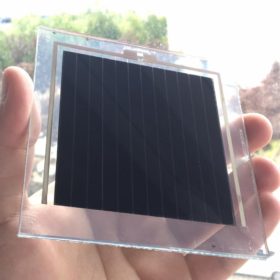
Perovskite solar cell with improved stability via graphite electrode
The solar cell was built on a fluorine-doped tin oxide substrate coated with titanium dioxide, an electron selective layer made of mesoporous titanium dioxide, a zirconium dioxide insulating spacer layer, and a graphite electrode. A mini-module fabricated with this cell passed, for the first time, a hotspot test.
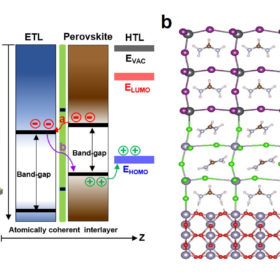
Korean researchers achieve 25.8% efficiency for single junction perovskite solar cell
The record efficiency was obtained thanks to an interlayer placed between the electron-transporting layer and the perovskite layer, which eliminated the need for passivation. The cell was also able to retain around 90% of its initial efficiency after 500 hours under standard illumination.
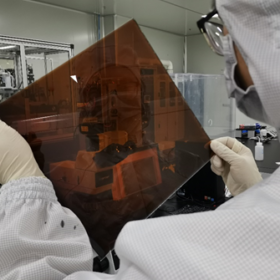
Chinese PV Industry Brief: Shuangliang signs billion-dollar wafer contract
This week, Shuangliang Eco-Energy has signed a multi-year sales contract for delivery of its PV wafers to solar cell manufacturer Jiangsu Runergy, and Wuxi-based perovskite start-up UtmoLight Technology has won a Pre-A round investment of RMB 220 million from several private equity funds.
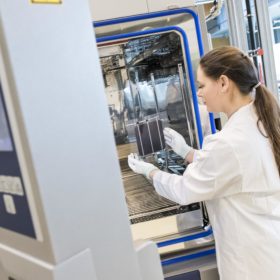
Perovskite solar pioneers honored with prestigious prize
The work undertaken separately by seven academics to discover the promise of perovskite materials for solar, and to open the door to high-efficiency devices, has been recognized by the judges of the Rank Prize for Optoelectronics.
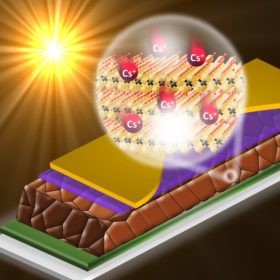
Doping delivers improved performance for perovskite solar cells
Some of the world’s largest solar PV module manufacturers are warning about looming panel shortages, but Australian researchers have declared that the industry is now drawing closer to a new generation of cheap, sustainable and efficient solar cells.
Building perovskite solar cells with waste toner carbon
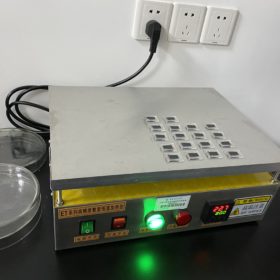
Scientists in China have fabricated 11.78%-efficient fully printable perovskite solar cells by using an electrode made of waste toner carbon from printer cartridges. The cell achieved an open-circuit voltage of 0.88 V, a short-circuit current density of 24.64 mA cm, and a fill factor of 54.56%.
Russian scientists achieve 21.1% efficiency in perovskite solar cell via Mie-resonant silicon nanoparticles
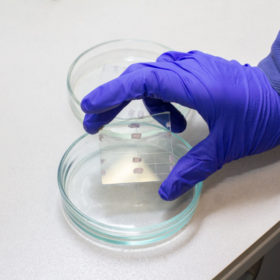
A Russian-Italian research group has developed resonant silicon nanoparticles that are claimed to improve the performance of perovskite solar cells. These particles serve as nanoantennae – they catch light and it resonates inside them, which amplifies the cell’s light absorption.
