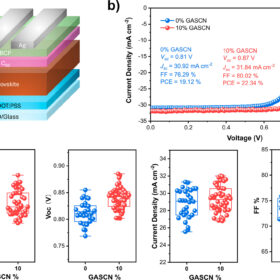
Researchers use guanidinium thiocyanate to raise perovskite cell efficiency
Researchers have used guanidinium thiocyanate as a chaotropic agent to modulate the crystal growth rate during perovskite crystallization. They compared different concentrations of the guanidinium thiocyanate. Champion device efficiency was 22.34%.
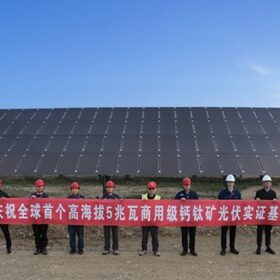
Huaneng switches on 5 MW perovskite solar test facility in China
Huaneng has commissioned a 5 MW perovskite PV demonstration plant in China’s Qinghai province to test performance, durability, and environmental adaptability under high-altitude, high-UV conditions.

Sumitomo Heavy unveils reactive plasma tech for thin-film perovskite PV
Sumitomo Heavy Industries (SHI) has developed a new reactive plasma deposition (RPD) method to form ultra-thin tin oxide electron transport layers (ETL) for perovskite solar cells. It claims this enables low-temperature mass production with minimal substrate damage.

Indoor perovskite solar cell built with triple passivation strategy achieves 37.6% efficiency
An international research team has constructed an indoor perovksite PV device by using a triple passivation treatment to reduce crystal defects in the perovskite film. The cell achieved remarkable efficiency and was also able to retain 92% of its initial performance after 3,200 h.
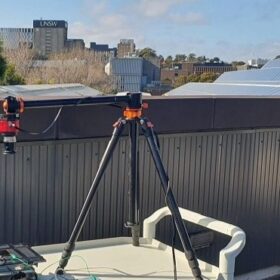
Using photoluminescence, implied open-circuit voltage imaging for perovskite solar cell field testing
To evaluate the outdoor performance and stability of perovskite solar cells using contactless and noninvasive methods, an Australian and Chinese research team found a way to use photoluminescence imaging as well as demonstrating a proof of concept for implied open-circuit voltage (iVOC) imaging. Their research relied on cost-effective equipment that operates under direct sunlight.
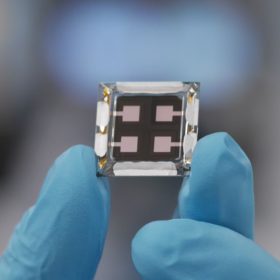
Four-year outdoor testing shows perovskite solar cells suffer from high seasonality
Testing conducted by the Helmholtz-Zentrum Berlin (HZB) in Germany has shown that perovskite solar cells operating at high latitudes in Europe may suffer from higher performance losses in winter compared to conventional PV devices. The scientists warned, however, that at lower latitudes this seasonality may be less pronounced.

NREL, CubicPV achieves 24% efficiency for perovskite mini solar module
A U.S.-based collaboration between the National Renewable Energy Laboratory (NREL) and CubicPV has yielded a perovskite minimodule with certified efficiency of 24.0%. The two noted that it is the first time a U.S. effort has set a record in the perovskite mini module category.
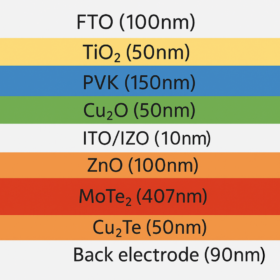
First attempt to build tandem solar cells based on perovskite, transition metal dichalcogenide
Scientists in India have proposed to design new tandem solar cells using transition metal dichalcogenide as an absorber material for the bottom PV device. Their simulations showed these tandem cells may reach an efficiency of over 35%.
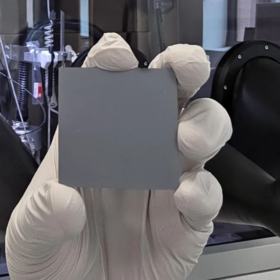
UK researchers developing new type of cadmium telluride PV panels for space applications
A team of UK researchers is working on lightweight cadmium telluride (CdTe) solar devices for space arrays. The aim is to develop 20%-efficient ultra-thin devices to provide lightweight, compact, lower cost solar power for satellites and space-based manufacturing applications.
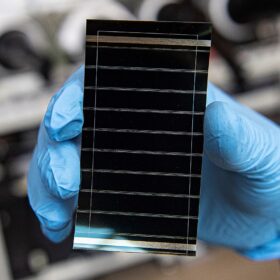
Bottom-up cost model for perovskite solar module manufacturing
Scientists in Switzerland have conducted techno-economic analysis of perovskite solar module manufacturing costs in terms of levelized cost of energy and have found that these products could be competitive in the Alpine country provided that they achieve an efficiency of over 24% with a lifespan of 20 years and over 20% with a lifecycle of 30 years.
