
New surface texturing boosts TOPCon solar cell efficiency by 1%
Chinese researchers have demonstrated a single-step submicron structured surface texturing process that improved the absolute efficiency of a TOPCon solar cell by 1% through broadband anti-reflection and lower electrical resistance. The cell-level performance was validated in laboratory and outdoor tests.

Power Roll testing new metrology for perovskite solar
The UK-based perovskite solar PV specialist has announced a new metrology research project with Swansea University and a new development agreement with Renolit, a German plastic films, sheets and polymer solutions company.
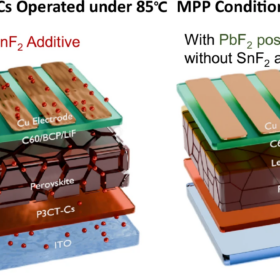
Scientists build tin lead perovskite solar cell with 24.07% efficiency
A Chinese-Swedish research team has boosted the performance of tin-lead perovskite solar cells by modifying additives and post-treatment processes. The device also demonstrated improved stability, retaining 60% of its initial efficiency after 550 hours at 85 °C under maximum power point conditions.

Scientists achieve 32.6% efficiency in perovskite-silicon tandem solar cell via interface engineering
Researchers from KAUST, TU Delft, and LMU Munich have improved the performance of monolithic perovskite-silicon tandem solar cells by modifying the physical structure at the front of the bottom heterojunction solar cell.

Scientists achieve 25.4% efficiency in perovskite solar cells with enhanced stability using multivalent ligands
Researchers have used multivalent amidinium ligands to boost perovskite solar cell efficiency to 25.4%, achieving over 95% stability after 1,100 hours at 85 C. The proposed approach enables controlled low-dimensional passivation layers, offering a practical route for durable, large-area perovskite devices.
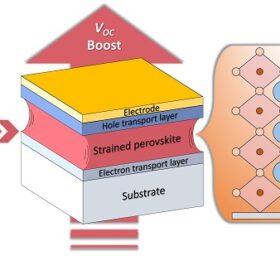
EPFL researchers enhance perovskite solar cell performance via rubidium
Researchers led by Michael Grätzel at the Ecole Polytechnique Federale de Lausanne in Switzerland have recently led efforts to improve perovskite optoelectronic properties using small-radius rubidium ion chemistry to enable more stable and efficient perovskite solar cells.

Japanese airport terminal hosting chalcopyrite solar modules
In two separate projects Japan-based Kyuden Mirai Energy and Nissan Motor are demonstrating the use of flexible, glass-free chalcopyrite PV panels provided by PXP Corporation.

China National Petroleum Corporation achieves 25.05% efficiency for inverted perovskite solar cell
The Chinese energy and oil company said the cell can be used as a top device in perovksite-silicon tandem configurations. The result was confirmed by the Shanghai Institute of Microsystem and Information Technology (SIMIT).
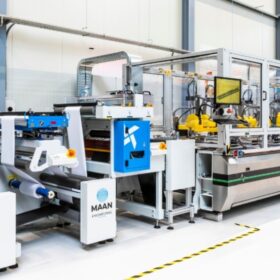
TNO offers mass customization line for integrated PV applications
The Dutch research institute’s highly automated research line offers customized, flexible solar semi-finished PV products to partners developing integrated PV applications.

‘Back contact will reach cost parity with TOPCon before end of decade’
During a pv magazine Week Europe 2025 webinar, panelists forecast back contact (BC) solar cells’ market share will draw level with TOPCon towards the end of the decade, before tandem technology begins large-scale momentum in the early 2030s.
