Scientists achieve 32.6% efficiency in perovskite-silicon tandem solar cell via interface engineering

A research team from Delft University of Technology (TU Delft), King Abdullah University of Science and Technology (KAUST), and Ludwig-Maximilians-Universität München (LMU Munich) has shown that controlling nanoscale surface roughness at the recombination layer in perovskite-silicon tandem solar cells can improve performance.
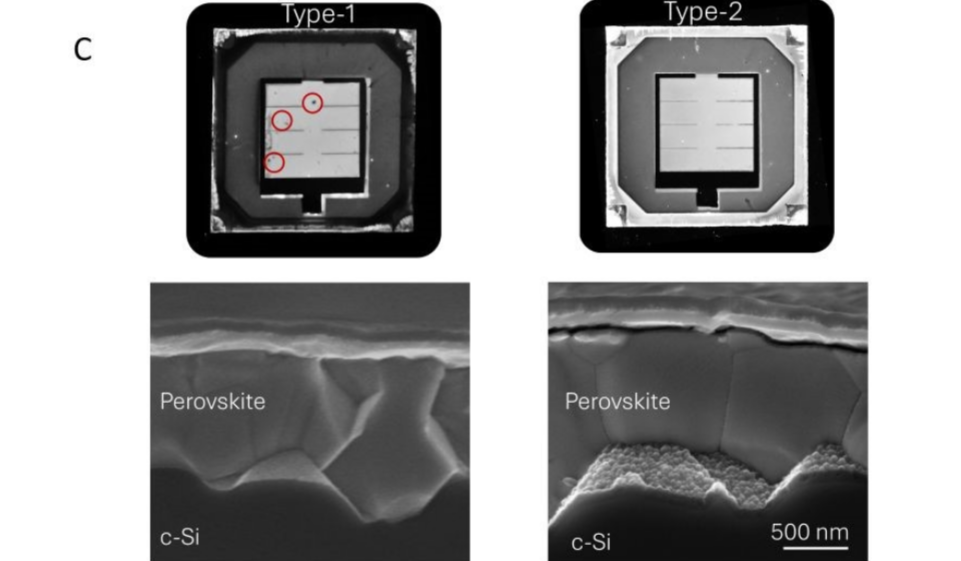
Noting that the influence of the crystalline silicon (c‑Si) bottom cell nanoscale surface roughness has received far less attention than perovskite optimization, the researchers investigated the effects of surface modification of the silicon heterojunction (SHJ) bottom cell to understand the impact of the surface nanoroughness on tandem device performance.
“The key novelty of our study lies in demonstrating that the nanoroughness of the recombination junction can be deliberately engineered to significantly improve the performance of perovskite-silicon tandem solar cells,” Erkan Aydin, co-corresponding author of the research, told pv magazine. “By systematically tuning the surface morphology at the nanoscale, we improved electrical contact quality and reduced recombination losses, which led to reproducible and higher efficiency results.”
“This provides a new design parameter that is compatible with existing silicon heterojunction technology,” added Aydin.
The team’s tandem optimization approach is differentiated from those that focus on materials composition, interface passivation, or optical management. “Our design strategy complements these efforts by addressing the physical structure of the recombination junction itself. Importantly, this approach does not require new materials or complex processing steps, making it highly synergistic with established silicon heterojunction and perovskite fabrication routes,” said Aydin, adding that it offers a “scalable and manufacturable pathway to further boost tandem performance.”
In the study, the team investigated variations in thickness and plasma treatments of n-type (n) hydrogenated nanocrystalline silicon ((n)nc-Si:H) thin films. “We tailored the (n)nc-Si:H nanoroughness by (i) adjusting the thickness of the (n)nc‑Si:H layers and (ii) applying plasma treatment using a hydrogen (H2) and carbon dioxide (CO2) gas mixture for varying durations prior to (n)nc‑Si:H layer depositions,” it said.
In testing, both methods were found to enhance the conductivity and crystallinity of (n)nc-Si:H layers and increase the surface nanoroughness, with plasma treatment enabling the efficient realization of distinct nanoroughness in thin (n)nc-Si:H (15-nm-thick) layers.
The systematic variation of the plasma treatment duration enabled controlled variation of the surface nanoroughness of textured c-Si bottom cells, promoting improved tin-doped indium oxide (ITO)/hole transport layer (HTL)/perovskite interfaces, which enhanced tandem device performance, according to the research.
“Our results reveal that the surface nanoroughness imposed by (n)nc-Si:H layers influences the self-assembled monolayer (SAM) anchoring, leading to increased work function shifts and improved SAM/perovskite interface quality, thereby impacting the overall tandem device performance,” said the researchers.
“Notably, tandem devices incorporating higher-nanoroughness bottom cells achieved increased fill factors, dominating the observed tandem efficiency enhancements, with a peak efficiency of 32.6% enabled by a 30-second-long plasma treatment,” they concluded.
The new process has potential not only in perovskite-silicon tandems but also several other cell technologies. “While our work is demonstrated in perovskite-silicon tandems, the concept is broadly applicable to silicon heterojunction devices and other crystalline silicon technologies that employ similar thin films,” said Aydin.
The study is detailed in “Tuning the surface nanoroughness of the recombination junction for high-performance perovskite-silicon tandem solar cells,” published by EES Solar.
Looking ahead, each research group is continuing to investigate key aspects of perovskite and silicon solar technologies. The team at LMU Munich is currently working on how the interfaces can be improved further by surface treatments. “We are also exploring how nanoscale morphology, chemistry, and mechanical stress interact in next-generation perovskite and tandem devices, with a strong focus on long-term stability and compatibility with industrial manufacturing,” said Aydin.
At TU Delft the researchers will tap state-of-the-art equipment at its PV Technology Center for future-oriented crystalline silicon technologies, according to co-corresponding author Yifeng Zhao told pv magazine. The group uses advanced characterization and modeling techniques to design and fabricate innovative, stable and high-performance solar cells.
The KAUST Photovoltaics lab (KPV-lab) is focused on bringing emerging photovoltaic technologies closer to the market. “We work on perovskite and silicon technologies in single-, dual- and triple-junction configurations for various applications. Tailoring PV cell and module technologies for deployment in hot and sunny climates holds particular interest,” Stefaan De Wolf, co-corresponding author, told pv magazine.
This content is protected by copyright and may not be reused. If you want to cooperate with us and would like to reuse some of our content, please contact: [email protected].

Please login to comment