
All-perovskite tandem PV cell based on carboranes hits 27.2% efficiency
Researchers have developed a thermal regulation strategy to improve the performance of inverted tin-lead perovskite tech for all-perovskite tandem solar cells. It has an efficiency of 23.4% and contributed to a 27.2% efficiency in a tandem cell while ensuring stability.
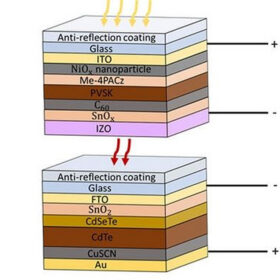
U.S. scientists demonstrate 25%-efficient perovskite-cadmium tandem solar cell
The researchers say the cell has a top perovskite cell with a transparent back contact made of indium zinc oxide and a commercially established cadmium telluride bottom device. They claim the champion tandem cell has the potential to reach a 30% efficiency.

Improving perovskite solar cell performance with phenethyl ammonium chloride
An international research team developed a perovskite solar cell performance-boosting treatment based on phenethyl ammonium chloride (PEACl) that is also claimed to reduce the number of process steps. With this technique, the group built a champion device with a 20.9% efficiency.
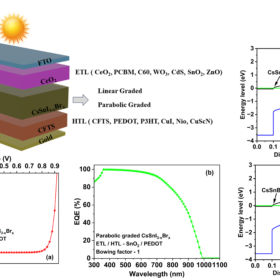
Indian scientists design lead-free perovskite solar cell with 23.61% efficiency
Developed through bandgap engineering and material design, the proposed PV device relies on a tin-based perovskite material known as CsSnI3-xBrx. It can reportedly be further designed to achieve power conversion efficiencies exceeding 24%.
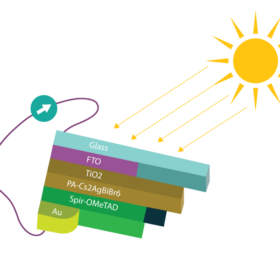
New doping strategy increases lead-free perovskite solar cell efficiency
An international research group has developed a solar cell based on a lead-free perovskite material known as Cs2AgBiBr6. The cell’s absorber was doped with trans-polyacetylene, which reportedly helped the device to improve its efficiency by more than 20%.
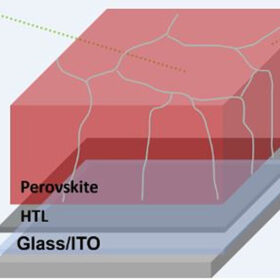
Tin halide perovskite solar cell based on new precursor additive achieves 12.22% efficiency
An international research team has developed a new type of perovskite solar cell by using 4-phenyl thiosemicarbazide (4PTSC) as a precursor additive. The device showed an improved open-circuit voltage and “exceptional” long-term stability.
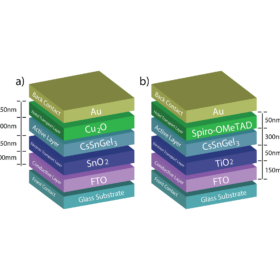
Researchers design tin-germanium-based perovskite solar cell with potential efficiency of 31.49%
Researchers in Malaysia have simulated a mixed cation perovskite solar cell integrating tin and germanium in the absorber. By modulating the perovksite layer thickness, they were able to achieve an efficiency ranging from 24.25 % to 31.49 %
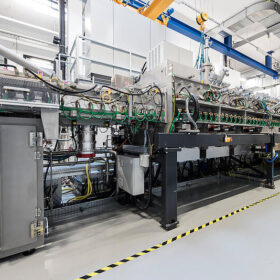
ZSW, First Solar partner to collaborate on thin-film PV
Zentrum für Sonnenenergie- und Wasserstoff-Forschung Baden-Württemberg (ZSW) and First Solar have agreed to work together to develop thin-film PV technologies on a gigawatt scale.
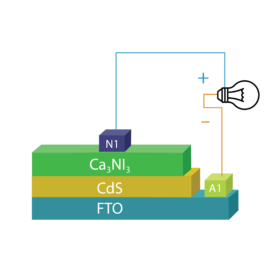
Researchers design 31%-efficient perovskite solar cell based on calcium nitrogen iodide
An international team has demonstrated a perovskite solar cell relying on inorganic calcium nitrogen iodide (Ca3NI3) perovskite and has found this absorber material offers advantages such as tunable bandgap and resistance to heat. The device achieved a fill factor of 81.68%.
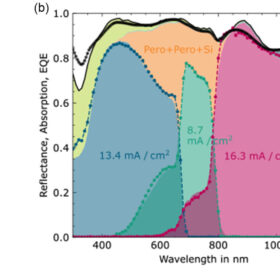
Perovskite-perovskite-silicon triple-junction solar cells have technical potential to reach 44.3% efficiency
A German research team has investigated the optical properties of perovskite/perovskite/silicon triple-junction cells and has found these devices may have a practical efficiency potential of 44.3% assuming idealized electrical parameters. These cells may also potentially achieve a fill factor of 90.1%.
