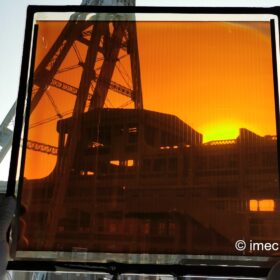
Imec unveils 781 cm2 bifacial perovskite solar panel with 11.9% efficiency
Scientists in Belgium have developed perovskite solar panels with a thermally stable device stack. The encapsulated bifacial panels they created with this configuration were able to retain around 92% of their initial efficiency after 1,000 hours.

Copper thiocyanate to eliminate moisture leaks in perovskite PV cells
Indian scientists have replaced Spiro-OMeTAD with copper thiocyanate (CuSCN) as a hole-transporting material in a perovskite solar cell. They say that the new precursor can offer the same efficiency levels, while reducing moisture leakage.
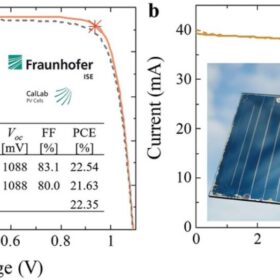
Slot-die coated perovskite PV cell with precursor ink hits 22.54% efficiency
German researchers claim to have reduced ribbing effects in using slot-die coating for the production of perovskite solar cells. The results are reportedly the most efficient solar cell built with this technique to date.
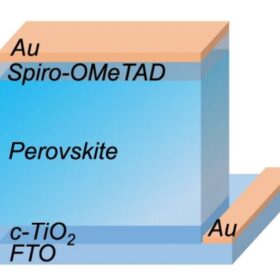
Perovskite solar cell with 25.3% efficiency via new ligand
A research group in China has designed a perovskite solar cell with a new ligand known as 3-amidinopyridine. These molecules are reportedly able to efficiently reduce anion vacancy defects, thus ensuring higher power conversion efficiency and remarkable stability.

Only5mins! – How a floating solar-powered artificial leaf generates synthetic fuels
University of Cambridge researcher Dr Virgil Andrei sits down with pv magazine to discuss an innovative ultra-thin film device capable of generating clean synthetic fuels while floating merrily on the River Cam.
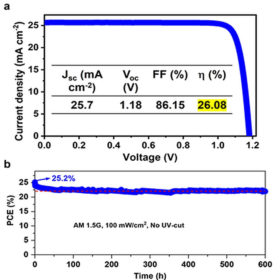
Perovskite alkylammonium chloride solar cell achieves 26.08% efficiency
The US National Renewable Energy Laboratory (NREL) has certified that a South Korean research team has achieved a 25.73% efficiency rating with a perovskite PV cell based on alkylammonium chlorides. The champion device built by the scientists reached an efficiency of 26.08%.
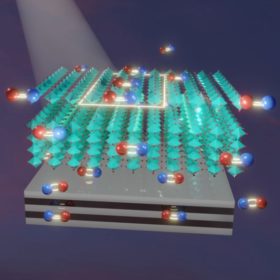
US scientists improve photoresponsivity in solar perovskite by 250%
Researchers led by the University of Rochester claim to have increased the photoresponsivity of a lead-halide perovskite for solar cell applications by 250%. They created a perovskite film with a plasmonic substrate made of hyperbolic metamaterial and characterized it with transition dipole orientation.

Tandem perovskite-silicon solar cells retained 80% of efficiency after 1 year
Saudi Arabia researchers claim to have improved the outdoor stability of a tandem perovskite-silicon solar cell by using proper encapsulation. By the end of the first year of operation, the cell’s fill factor remained above 70%.
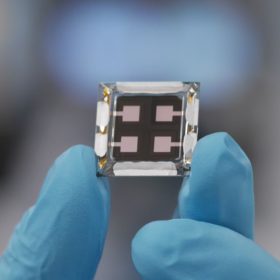
Inverted perovskite solar cell with 24.1% efficiency
An international research group has developed an inverted perovskite solar cell with an active area of 9.6 mm2 by using polymer dipoles for interfacial engineering. It retained 96% of its initial power conversion efficiency after continuous maximum power point (MPP) tracking for 1,000 hours.
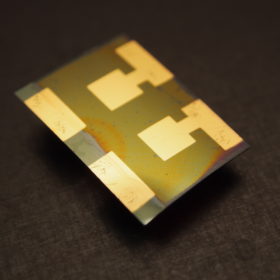
Scientists assess lifetime for perovskite PV to become competitive on rooftops
Researchers say that lightweight, high-performance perovskite solar modules could soon become competitive with crystalline PV modules in the residential segment, as such products will likely have lower manufacturing and balance-of-system costs in the future.
