All-perovskite tandem solar cell with 27.1% efficiency via gas quenching

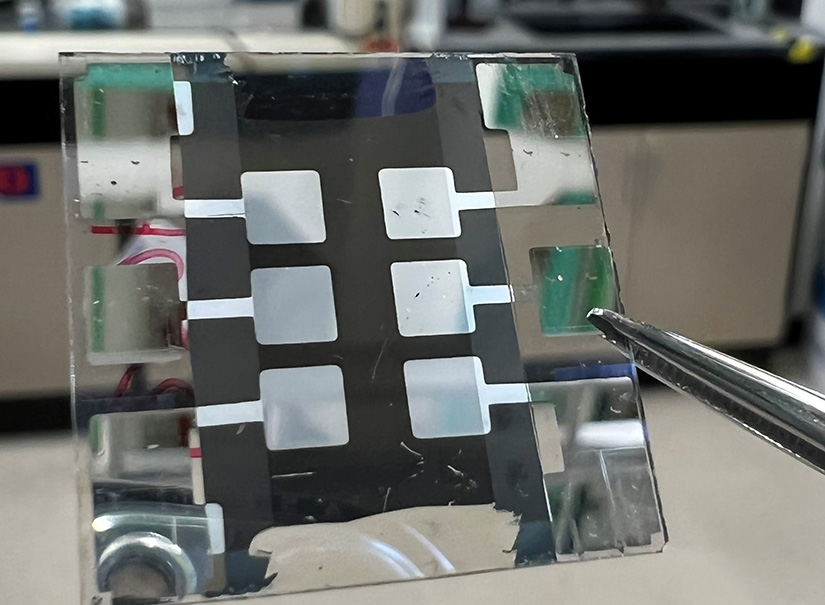
NREL researchers have fabricated an all-perovskite tandem solar cell with perovskite films to show reduced defect density and achieve a power conversion efficiency of 27.1%.
The new cell builds on another inverted perovskite solar cell fabricated with p-i-n structure, which was unveiled by the research group in September. This device, according to the scientists, was able to retain 87% of its original efficiency after 2,400 hours of operation at 55 C.
For the new cell, the group did not use an antisolvent to create a uniform perovskite film and used instead gas quenching, which consists of cooling the parts of a material down from critical temperature quickly in order to strengthen and harden. It is commonly used to maintain the properties associated with a crystalline structure or phase distribution.
“The result addressed the problem of the bromine and iodine separating, resulting in a perovskite film with improved structural and optoelectronic properties,” the scientists explained. “The gas-quenching process, when applied to high-bromine-content perovskite chemicals, forces the crystals to grow together, tightly packed from top to bottom, so they become like a single grain and significantly reduces the number of defects.”
Through this approach, the researchers were able to achieve a 20% efficiency for the wide-bandgap layer, which also showed operational stability, with less than 5% degradation over 1,100 hours.
When connected to a 1.25 eV narrow-bandgap bottom perovskite cell, the perovskite layer was able to bring the overall cell efficiency to 27.1% and its open-circuit voltage to 2.2 V.
“The gas-quench method is a general way for improving the performance of wide-bandgap perovskite solar cells,” said the scientists.
They presented the cell tech in “Compositional texture engineering for highly stable wide-bandgap perovskite solar cells,” which was recently published in Science.
“The new growth approach demonstrated the potential of high-performance all-perovskite tandem devices and advanced the development of other perovskite-based tandem architectures such as those that incorporate silicon,” they concluded.
This content is protected by copyright and may not be reused. If you want to cooperate with us and would like to reuse some of our content, please contact: [email protected].

Please login to comment