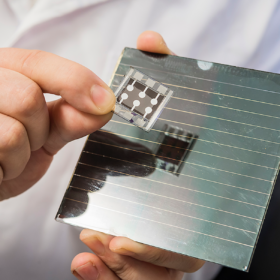
Perovskite solar cell achieves higher stability with new tin oxide layer
Using atomic layer deposition, a research team from the City University of Hong Kong has created an an oxygen-deficient tin oxide layer to replace the more common fullerene electron transport layer in perovskite solar cells. The result is a 25%-efficient device that is able to retain around 95% of its efficiency after 2,000 h.
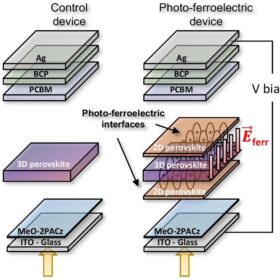
Solar cell based on ferroelectric 2D/3D/2D perovskite junction achieves 24% efficiency
The experimental device achieved an open-circuit voltage of 1.21 V, which is the highest value reported to date for highly efficient perovskite photovoltaics. The cell is based on a photo-ferroelectric 2D/3D/2D perovskite junction integrating a 2D ferroelectric perovskite single crystals in the perovskite bulk.
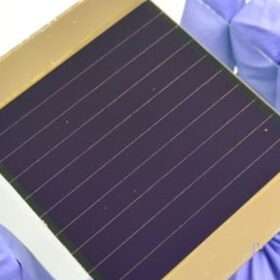
Perovskite solar module achieves 21.44% efficiency via new passivation tech
Researchers have developed a novel passivation process for formamidinium lead iodide perovskite films, which reportedly resulted in solar cells with 23.69% power conversion efficiency, and modules with 21.44% certified efficiency. After 1000 hours, the hetero-polytypic passivated devices maintained 92% of their initial efficiency, outperforming untreated devices.

Flexible perovskite solar cell based on polycarbonate substrates achieves 13.0% efficiency
An international research group demonstrated the first perovskite solar cells on polycarbonate substrates, suitable for flexible PV applications. Using an industrially compatible fabrication method, the group produced devices with 13.0% power conversion efficiency, 87% of which was maintained after 1000 bending cycles at a radius of 20 mm.

Italian scientists build 12.6%-efficient nickel oxide-based large-area perovskite solar modules
An Italian research group has fabricated 110 cm² perovskite solar module with an inverted configuration and a hole transport layer that uses nickel oxide instead of commonly utilized poly(triarylamine) (PTAA). The proposed architecture aims to achieve high efficiency that is competitive with PTAA-based panels while improving stability.

EU-funded project seeks set up pilot production of large-area perovskite PV modules
The EU-funded Laperitivo project aims for 22% efficiency in 900 cm² opaque perovskite modules and 20% efficiency in semi-transparent ones. The project partners include imec, Fraunhofer ISE, TotalEnergies, and EDF.
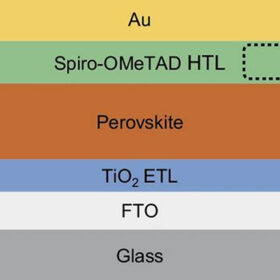
Perovskite solar cell based on lithium salt-doped spiro-OMeTAD achieves 25.45% efficiency
Researchers in China have proposed a new lithium-free doping strategy to fabricate spiro-OMeTAD-based hole transport layers (HTLs) for applications in perovskite solar cell. A PV device built with a salt-doped HTL achieved a record-breaking efficiency of 25.45%.
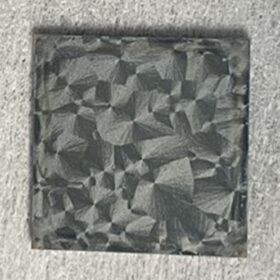
Terpyridine-passivated perovskite solar cells achieve 25.24% efficiency
An international team of researchers demonstrated perovskite solar cells treated with a molecular passivator based on π-conjugated terpyridine Lewis-base molecules that achieved 25.24% power conversion efficiency, with 90% retained after 2,664 hours of light exposure. The treatment reportedly works at high concentrations without damaging the perovskite film or diminishing cell performance. A protocol was published to reproduce the results, opening the door to testing it on a range of perovskite absorbers.

Photon shifting, trapping enable 28.2% higher photocurrent in perovskite solar cells
Researchers in Portugal adopted a new light trapping strategy to build an ultrathin perovskite solar cells that may reportedly have a longer operational lifetime. They utilized an LDS coating combined with a checkerboard photonic front structure to protect the cells against UV-enabled degradation and simultaneously improve UV irradiation.
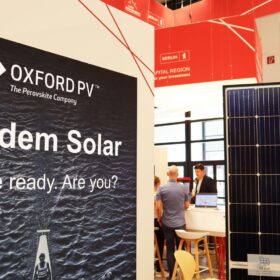
Oxford PV starts commercial distribution of perovskite solar modules
Oxford PV is delivering its first commercial perovskite solar modules to US customers. The 72-cell solar modules have an efficiency of 24.5% and, according to the company, can generate up to 20% more energy than conventional silicon modules.
