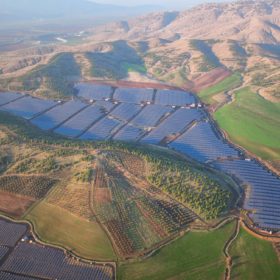
Mixed reaction from solar industry to plunging Turkish currency
As the lira’s troubles continued to weigh on the markets today, it remained unclear how the country’s solar market will be affected. While the plunging currency fosters uncertainty – public enemy number one for investors – it could also create conditions for lower system costs and cheaper PV projects. Nevertheless, a serious slow-down for 2018 must be considered.
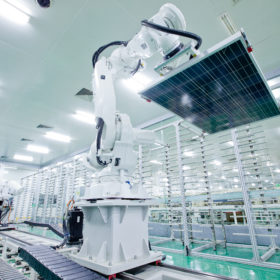
Jinko sees Q2 profits slightly increase, confirms shipment outlook for fiscal 2018
The Chinese manufacturer has seen its revenue decline significantly in the second quarter of this year, despite quarterly shipments dropping just 3.1%. This performance, which confirms a trend that was already clear in fiscal year 2017, was mainly due to lower solar module ASPs. Quarterly net profit, however, has more than doubled. Despite recent developments in the Chinese PV market, the company maintains its shipment outlook for full fiscal year 2018, in which it hopes to ship between 11.5 GW and 12 GW.

China sets up International Investment Alliance for Renewable Energy
Although the Chinese government has recently scaled back solar energy development, it has created a new, large, alliance to reach more foreign markets. In addition to focusing on the shipment of PV modules, it will also address financing, EPC and O&M services.
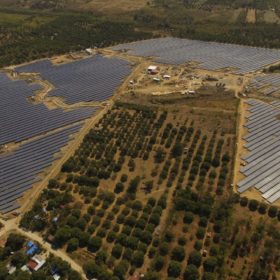
Philippine utility Meralco receives Southeast Asia’s lowest solar bid
In a tender for 50 MW of solar, local PV module manufacturer and project developer, Solar Philippines submitted a bid of P2.34 (US$0.044) per kWh.
Centrotherm order intake from PV industry remains below expectations
The German PV equipment provider has improved sales and results in the first half of the year. The company, however, received more orders from the semiconductor and microelectronics industries. In the next 12 months, centrotherm expects new orders from the Chinese solar industry.
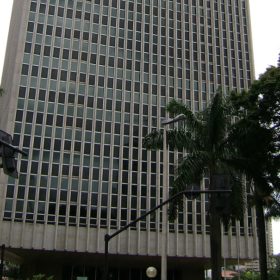
Brazil’s Cemig to hold second wind, solar auction
Although the volume has not been disclosed, selected projects in this new auction will have to start delivering power by January 2022. In the first auction of this kind, held in June, the Brazilian power provider contracted 431.4 MW of wind and solar power.

Argentina suspends RE auctions
The planned fourth round of the RenovAr program will probably not be held this year or next. The Argentinian government says grid constraints and difficult financing conditions may increase the auction’s prices.

UPDATE: ACWA offered lowest bid in Egypt’s 200 MW tender
As pv magazine has learnt, the Saudi energy giant lowered its offer to $0.02752/kWh at the last minute, beating the bid lodged by Spain’s Fotowatio, which offered $0.02791 per kWh.
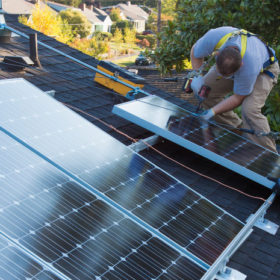
Study: 32% tandem cell solar still competitive at triple the price
Arizona State University researchers have determined that a 32% efficient perovskite-silicon tandem cell could produce electricity at the same price as cutting-edge 22% efficient panels in the most cost-competitive of situations
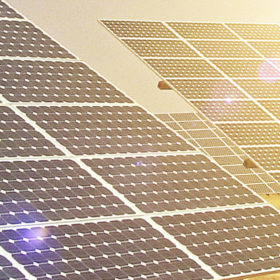
Canadian Solar secures funds for 68 MW Mexican project
The $45 million loan was granted by French financial services provider, Natixis. The solar facility, selected by the Mexican governmemt in the first energy auction of 2016, will be located in the state of Aguascalientes.
