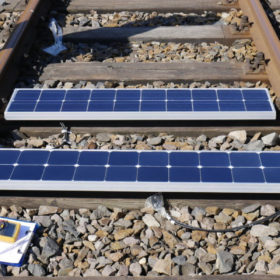
Solar for railways
Germany’s TÜV Rheinland is investigating how photovoltaics could be used for powering railway traction networks in a 14-month research project.
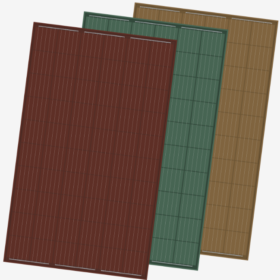
Colored BIPV panel with 350 W output from Italy
Italian manufacturer Solarday has launched a glass-glass building-integrated monocrystalline PERC panel available in red, green, gold and grey color. Its power conversion efficiency is 17.98% and its temperature coefficient is -0.39% per degree Celsius.
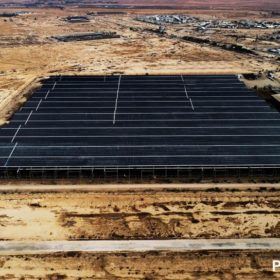
Israel allocates 1.14 GW of PV across two tenders, lowest price comes in at $0.02751/kWh
The Israeli authorities allocated more than 1.14 GW of PV capacity and 210 MWh of storage across two different tenders. In a first procurement exercise for the 330 MW/210 MWh Dimona solar-plus-storage project the winner was Israeli company Shikun & Binui Holdings Ltd. In another tender for innovative PV projects local developer Prime Energy secured 475 MW with the final average price of $0.0541/kWh.
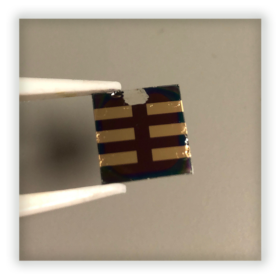
Paired with ‘wonder material,’ over 21% efficiency demonstrated in perovskite solar cells
The use of phosphorene nanoribbons boosted the cell, putting it on par with traditional silicon cell output levels.
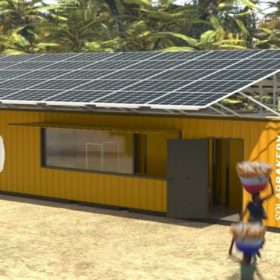
Solar bakery as a containerized solution
The 52 kW containerized solution is being developed by German start-up Solarbakery. The bakery’s production process was adapted in such a way that the majority of electricity consumption is already incurred during the day and is only baked briefly in the dark before dawn.
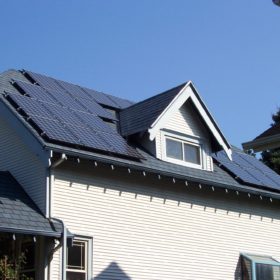
High energy prices mean big gains for smart-metered Belgian PV system owners
In the Belgian macro-region of Flanders, residential PV system owners that decided to install smart meters and abandon net metering are currently seeing their injection tariffs being paid at €0.11, up from just €0.03 in January. This gain adds to the high value of the kilowatt-hours they self-consume and it is helping them halve the payback time of their installations.
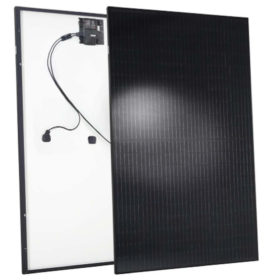
Hanwha Q Cells, Enphase launch 20.6%-efficient AC module in Europe
The AC module incorporates Enphase IQ 7+ microinverters and has now a higher wattage of 385 W.
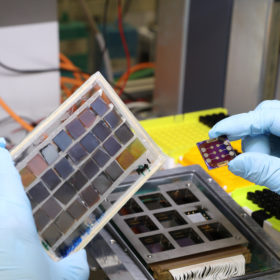
Perovskite solar cell retains 99% of initial efficiency after 1,450 hours
Developed by German researchers, the 20.9%-efficient device was built with an architecture avoiding the use of the ionic dopants or metal oxide nanoparticles that are commonly used to contact the cell, as these can be subject to secondary reactions at higher temperatures.
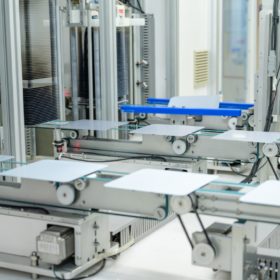
Jolywood switches on 1.5 GW TOPCon solar cell factory in China
The Chinese bifacial module maker has commissioned a 1.5 GW TOPCon cell factory in China’s Zhejiang province, which raised its total TOPCon cell capacity to 3.6 GW. Another 16 GW facility is being planned for the Shanxi province.

Rwanda seeks consultants to support development of mini-grids
The Development Bank of Rwanda wants to finance developers to build photovoltaic and mini-grids ranging in size from 10 kW to 1 MW.
