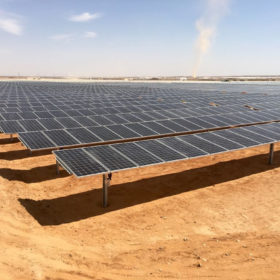
Jordan completes 250 MW second round of licensing
The kingdom has given the green light to a 50 MW proposal in Ma’an, the fifth project in the second round of its national commissioning process.

Portugal: A further 1.7 GW of PV projects under review
Portugal’s Directorate General for Energy and Geology is reviewing another big bunch of “unsubsidized” solar schemes.

VDMA: thin-film revives business of German PV equipment suppliers
Photovoltaic manufacturers across the world are currently investing mainly in thin-film production plants. The German PV equipment providers benefit greatly from this new trend.

$0.034/kWh solar bid equalled in India – but is it viable?
The state’s second attempt to tender for 500 MW of capacity has made a mockery of predictions of rising PV electricity prices and exonerated utility for cancelling previous procurement round. But the absence of India’s cheapest solar energy generator from the latest exercise could be telling.
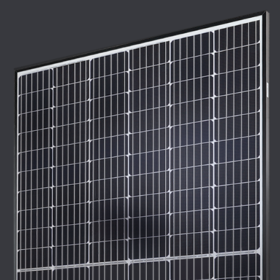
Hanwha Q Cells to make half-cut mono modules at U.S. factory
The Korean-European PV maker has revealed that its new U.S. factory will make modules based on half-cut monocrystalline cells using passivated emitter rear contact (PERC) technology.

Akfen Renewable Energies to receive $363 million loan for PV & wind projects
Turkey’s Akfen Renewable Energies this week signed a new $363 million loan with six international and Turkish banks, to build 327 MW of new solar and wind power capacity.
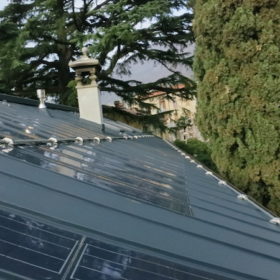
Italy extends fiscal incentive for residential PV to storage
The Italian Revenue Agency has clarified that the purchase and installation of a residential storage system linked to a rooftop PV system may also take advantage of the 50% of Irpef deduction, an indirect incentive that has played a major role in driving solar growth in the residential and commercial segments over the past years.
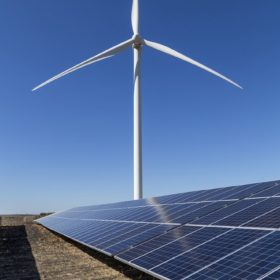
EDP secures 15-year PPA for 199 MW PV project in Brazil
The company’s renewable energy unit EDPR will sell power to an unnamed client from a solar plant to be located in Ferreira Barreto, in the Brazilian state of Sao Paulo. The Portuguese utility and wind power specialist began making investments in solar in recent times.
Enel Green Power breaks ground on tender’s first 85 MW solar farm in Spain
The site is the first to be constructed after last year’s exercise. A total of 3.9 GW was awarded, signaling a comeback for the Spanish solar market. The president of Spain’s solar association says there is 21 GW potential projects waiting to compete in future tenders.
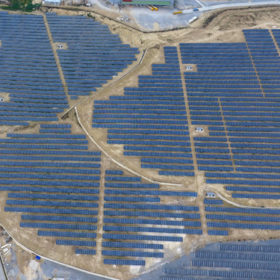
Turkey to launch 1 GW PV tender in January
Strong local content requirements may be embedded in the tender, according to the first draft of its rules, with selected projects required to rely on a 60% quota of modules made in Turkey. A 30 MW/ 90 MWh (AC) storage project will also be included at one of the three sites identified for the tender.
