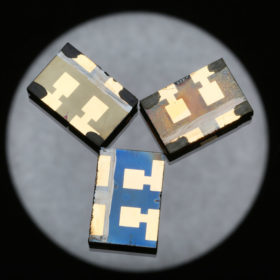
EU grants €5 million to perovskite research consortium
Belgian institute Imec will be the coordinator of a project involving many of Europe’s leading research organizations, which will focus on developing stable, scalable, low cost PV modules based on perovskite technology. The project, named ‘ESPResSo’ has received more than €5 million in funding from the European Union.
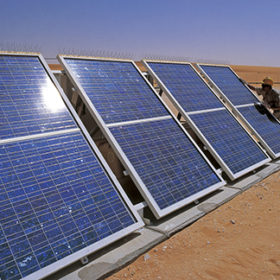
Eni to build 220 MW of solar at its Italian facilities
The Italian oil giant has already identified 25 sites where the solar plants could be located. The projects are part of the company’s €7 billion investment plan in Italy.
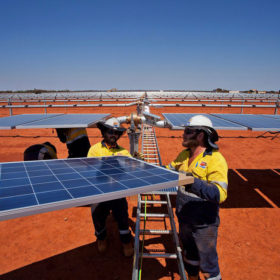
Australia: Fast-falling EPC prices make sub-$60/MWh solar feasible
Analysis from Rystad Energy has revealed that sub-AU$60/MWh utility-scale solar projects could be viable in sunny parts of Australia today. The highly competitive EPC landscape has been identified as the major driver of the improving PV power plant economics although, as always, cost of capital remains key.
Poland’s PV capacity reaches 281 MW
In 2017, newly installed solar power in Poland reached around 81 MW, the majority of which comprised PV installations 40 kW or smaller in size.
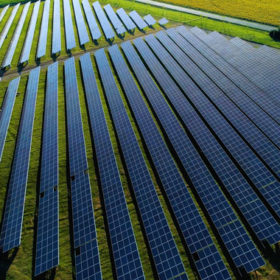
Total inks deal to acquire Direct Energie
The French oil group, which is the parent company of U.S. solar manufacturer, SunPower, is set to acquire a 74.33% stake in France’s third largest power utility, Direct Energie. With this move, Total is gearing up to expand its presence in the power sector, particularly in France and Belgium.

Blockchain project powered by 45 MW of solar launched in Spain
The project, expected to be finalized by April 2019, is being planned by Spanish blockchain platform, CryptosolarTech. A big cryptocurrency mining server, relying on 3,000 servers to mine cryptocurrencies, will be located near Malaga, in the southernmost part of Spain. Ten solar projects totaling 45 MW will provide the necessary power, the estimated aggregate investment of which is €42.8 million.
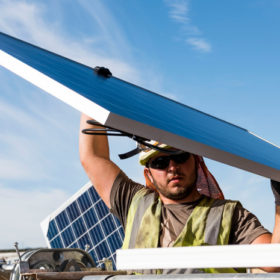
US: SEIA reports 18 companies reducing solar deployment, workforce in 2018
U.S. solar trade organization, Solar Energy Idustries Association (SEIA) has listed cancelled investments and hiring as well as job losses in its comments supporting requests for exclusion from Section 201 tariffs.

Fraunhofer ISE, Schmid develop production line concept for custom design modules
German research institute, the Fraunhofer Institute for Solar Energy Systems (ISE) and equipment supplier, Schmid have jointly developed a production line for customizable modules for building-integrated projects. According to Fraunhofer ISE, the concepts developed by joint study could reduce the production cost for BIPV modules as much as 35%.

Algeria to tender up to 170 MW of wind and solar
Through the tender, the Algerian government aims to deploy 50 MW of renewable energy generation capacity in the south of the country – where local power utility, Sonelgaz is currently still relying on diesel generators for electricity production – and another 100 MW to 120 MW at other unspecified locations.
Solargiga reports decline in shipments, turnover due to lower ASPs
In the first quarter of this year, the Chinese solar manufacturer registered a 34% drop in revenue, while quarterly shipments also declined around 19% year-on-year, to 462 MW.
