Philippine regulator opposes net metering expansion
The Philippines’ Energy Regulatory Commission (ERC) has said the removal of the 100 kW cap for solar installations under net metering would be difficult for the nation’s grid to accomodate. Meanwhile, a proposal to raise the threshhold is being discussed in the country’s Senate.

Greenpeace Energy wants to buy Germany’s RWE coal business, replace it with 8.2 GW of renewables
The Hamburg-based green electricity provider wants to shut down RWE’s coal power plants and replace them with 8.2 GW of wind and solar systems. Approximately €7 billion would be invested in the new facilities, which would be built without any public support. Key to the initiative will be citizen participation.
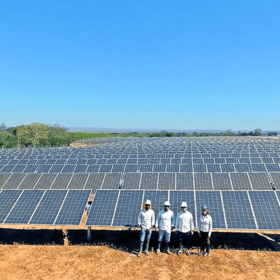
EDF, Canadian Solar receive financing for 399 MW (DC) Brazilian PV project
The Pirapora solar complex, located in the Brazilian state of Minas Gerais, began supplying electricity to the Brazilian grid in mid-2018.
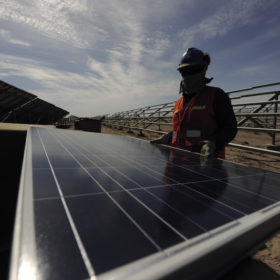
Argentina: Province of Santa Fe launches 50 MW mixed wind-solar tender
Through the tender, the province’s state-owned power provider Empresa Provincial de la Energía (EPE) intends to select PV power projects not exceeding 5 MW in size, and wind farms up to 10 MW. Selected projects will be awarded a 20-year PPA.

Niger commissions first solar park
The 7 MW solar facility will sell power to local state-owned utility Nigelec. The project was developed with the support of the Indian government.
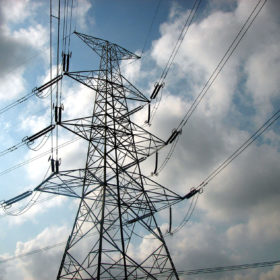
Belgium preps for energy transition with blockchain, AI and other innovations
Belgian grid operator Elia has published a vision paper explaining how it intends to link consumers’ behavior at lower voltage levels with price signals in the wholesale electricity market, thus also enabling better integration of renewables.

France sees increasing activity for private solar PPAs
Energy cooperative Enercoop has issued a request for proposal to select renewable energy projects up to 10 MW in size for which it could award a 15 to 30-year PPA. The move is intended to attract bids for projects built without public support.
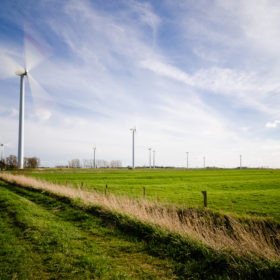
Wind the only winner in Poland mixed energy auction for projects over 1 MW
Unlike similar auctions in France and Germany recently, in which only PV projects were selected, in Poland all the contracted power went to wind. The exercise drew prices from $41.98/MWh to $57.73/MWh, for an average $52.19/MWh.

“We have to think about mistakes made due to excessive regulation”
The Spanish government’s zeal in reducing electricity market prices can hit investment in renewable projects, which need stability. pv magazine interviewed Antonio Delgado Rigal, a doctor in artificial intelligence and founding Partner and CEO of AleaSoft, to discuss market equilibrium, the impact on electricity prices of the measures applied and announced by the government, and the appropriate transformation of the energy model.

Japan plans abrupt FIT cut for delayed PV projects
The subsidy for solar schemes approved between 2012 and 2014, and that will be not completed by March, may be reduced to ¥21/kWh. The proposal is expected to affect projects with a combined capacity of more than 20 GW.
