
Perovskite quantum dot solar cell achieves record-breaking efficiency of 18.3%
Conceived by scientists in China, the cell was built with an alkaline treatment that modulates efficiently the perovskite quantum dots surface chemistry. The device reportedly achieved the highest power conversion efficiency ever reported for this kind of solar cells.
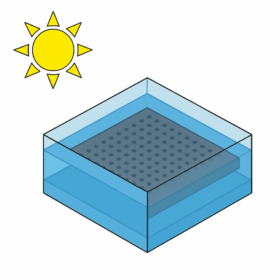
Cooling PV panels with stagnant water layer
Researchers have developed a stagnant water layer cooling concept and tested it using seawater, tap water, and desalinated water. The panel temperature decreased by up to 8.2 °C, while power output increased by approximately 28%.

Scientists develop new floating box array for offshore PV
Researchers have tested a 9 x 11 floating box array for offshore photovoltaics in a large wave flume, under regular and irregular wave sequences. They have placed wireless gyroscopes on three of the boxes, representing the front, middle, and rear positions.

New research confirms rooftop PV affects urban temperatures, cooling demand
Using Lyon as a case study, an international research team has simulated the effects of rooftop photovoltaic (PV) coverage in an urban area at three levels: 25%, 60%, and 100%. The results have shown that solar panels can raise daytime temperatures by up to 0.72 °C, while cooling nighttime temperatures by up to 0.42 °C. In addition, daytime air conditioning demand has decreased by about 5%.

Building-integrated concentrating photovoltaics for vertical applications
An Indian-British research team has developed a building-integrated linear concentrating PV facade by sandwiching an asymmetric compound parabolic concentrator, PERC cells, and encapsulation layers between two sheets of glass. The system was tested under both indoor and outdoor conditions and its payback period was found to be of up to 11 years.

DAS Solar developing 23%-efficient silicon solar cell based on carbon nanotubes
The Chinese module maker said the solar cell was developed with the support of Hebei University. The device uses a carbon nanotube-based hole transport layer that could be used in TOPCon and HJT structures to boost output and reduce complexity.
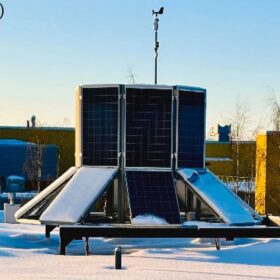
Carousel-shaped measurement platform for Arctic PV
Scientists in Finland have created a special platform to assess the performance of PV modules operating under Arctic conditions. Specifically, it provides data for efficient system design and performance modelling validation, with azimuth and tilt angle being key parameters.

New control strategy for grid-forming inverters
Researchers in the United States have created a droop control strategy for grid-forming inverters that purportedly improves power system frequency stability. By using an exponential active power–frequency relationship, the novel technique optimizes the use of available headroom, reduces frequency deviations, and enhances overall grid resilience.
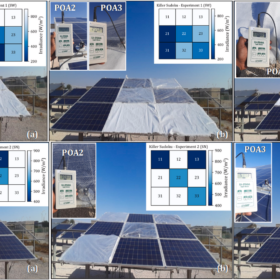
Using Asterisk Sudoku for PV system reconfiguration under shading conditions
Researchers in Qatar have used an algorithm relying on a variant of the popular logic-based puzzle to determine the optimal way to eliminate cluster shading. They have tested the new approach under fixed and moving shadows.

KAUST achieves 28.7% efficiency in perovskite-perovskite-silicon tandem solar cell
An international team of researchers led by King Abdullah University of Science and Technology has fabricated a triple junction perovskite-perovskite-silicon tandem solar cell that achieved a world record efficiency for this cell architecture. The device incorporates stabilized perovskites that ensure improved performance and stability.
