Study shows payback times for heat pumps could plunge by 2030
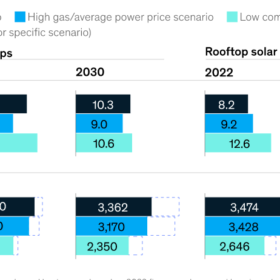
McKinsey & Company says in a new report that payback periods for heat pumps could fall by up to 38% by 2030.
The Hydrogen Stream: Israeli startup to make hydrogen powder in Netherlands
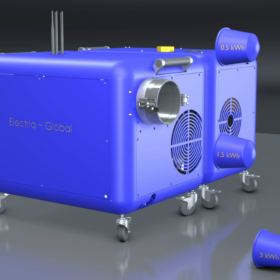
Electriq and Zenith Energy Terminals are teaming up on hydrogen powder production in Amsterdam, while Universal Hydrogen has completed the world’s first passenger flight based on hydrogen fuel cell propulsion.
Hybridizing photovoltaics with liquid air energy storage
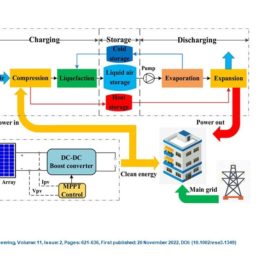
An international group of researchers has designed a new hybrid photovoltaic-liquid air energy storage (PV-LAES) system. Their economic evaluation for the proposed 2 MW PV-LAES project showed that the investment payback period can be within 10 years, and the accumulated net profit can reach up to $2.2 million from a life-cycle perspective.
Second-life EV batteries as grid-scale storage
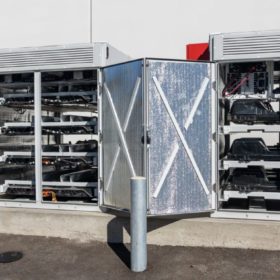
Smartville has secured $5.9 million from the US Department of Energy to scale its second-life battery program.
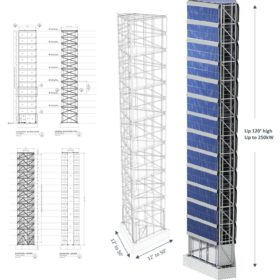
Solar tower of power shows benefits of vertical installations
Three Sixty Solar, a commercial and utility-scale solar developer, published a report this week that provides background on its vertically mounted solar system’s initial 16 months in operation.
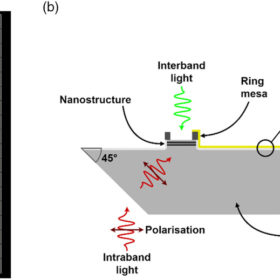
Novel design for intermediate band solar cells
A UK-Australian research group has built an intermediate band solar cell with a quantum ratchet semiconductor nanostructure that reportedly increases the ratchet band state lifetime of the device. Their new design builds on a cell structure known as the Vaquero–Stainer Device (VSD).
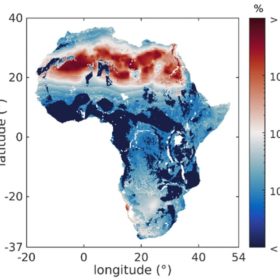
New model estimates PV potential for water pumping in Africa
An international team has developed a numerical model that calculates how much groundwater can be pumped by PV systems of different sizes across the entire African continent. The results show that larger PV systems do not always pump the highest volume of water.

Fraunhofer ISE founder, solar pioneer Adolf Goetzberger dies
Adolf Goetzberger, the founder of the Fraunhofer Institute for Solar Energy Systems ISE and an early proponent of photovoltaics, passed away on Feb. 24 at the age of 94.
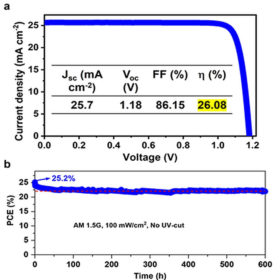
Perovskite alkylammonium chloride solar cell achieves 26.08% efficiency
The US National Renewable Energy Laboratory (NREL) has certified that a South Korean research team has achieved a 25.73% efficiency rating with a perovskite PV cell based on alkylammonium chlorides. The champion device built by the scientists reached an efficiency of 26.08%.
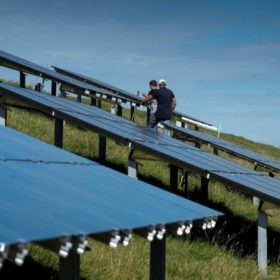
Dutch study confirms feasibility of PV plants on dikes
A Dutch consortium recently tested four different PV system configurations along water in the Netherlands. The country has approximately 17,000 km of dikes and a preliminary study has shown that they offer the potential for 11 GW of solar capacity.
