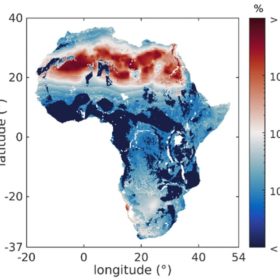
New model estimates PV potential for water pumping in Africa
An international team has developed a numerical model that calculates how much groundwater can be pumped by PV systems of different sizes across the entire African continent. The results show that larger PV systems do not always pump the highest volume of water.

Fraunhofer ISE founder, solar pioneer Adolf Goetzberger dies
Adolf Goetzberger, the founder of the Fraunhofer Institute for Solar Energy Systems ISE and an early proponent of photovoltaics, passed away on Feb. 24 at the age of 94.
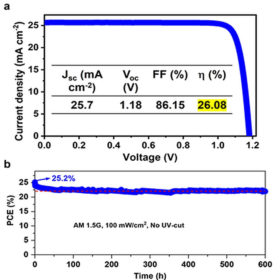
Perovskite alkylammonium chloride solar cell achieves 26.08% efficiency
The US National Renewable Energy Laboratory (NREL) has certified that a South Korean research team has achieved a 25.73% efficiency rating with a perovskite PV cell based on alkylammonium chlorides. The champion device built by the scientists reached an efficiency of 26.08%.
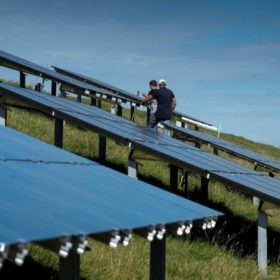
Dutch study confirms feasibility of PV plants on dikes
A Dutch consortium recently tested four different PV system configurations along water in the Netherlands. The country has approximately 17,000 km of dikes and a preliminary study has shown that they offer the potential for 11 GW of solar capacity.
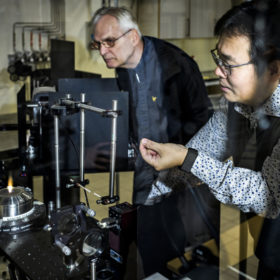
Storing solar power by incinerating metals
Scientists in Sweden have proposed the use of excess wind and solar power to incinerate metals such as aluminum and iron, in order to produce heat that could be used to generate electricity or hydrogen.
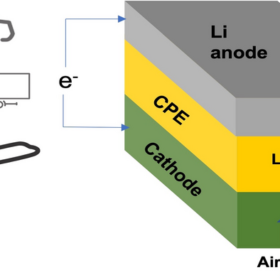
Lithium-air battery with solid electrolyte
US researchers have developed a new lithium-air battery with solid electrolyte and the potential to reach a record energy density that is nearly four times that of lithium-ion batteries. The test cell demonstrated stability over 1,000 charge and discharge cycles.
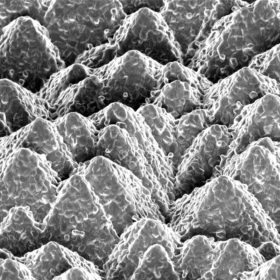
Scratching the surface of silicon in tandem solar cells
German scientists have investigated the role of surface texturing in perovskite-silicon tandem cells and have found that several new processes offer the ability to etch smaller, more uniform textures onto the surface of a silicon cell than today’s industry standard. This could help to ease the subsequent growth of a perovskite cell on top of the silicon, enabling researchers and manufacturers to target higher performance.
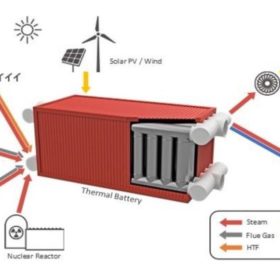
New thermal battery offers fast, efficient performance at low cost
US engineers have built a scalable thermal energy storage prototype system that combines the best latent and sensible heat transfers. The technology, which is now market-ready after three years of testing, consists of engineered cementitious materials and thermosiphons in a combination that enables fast, efficient thermal performance at low cost.

Machine learning predicts residential power yield of large PV system fleets
Dutch scientists have developed a PV forecasting method that uses the XGBoost algorithm. They claim their approach predicts electricity generation levels an hour ahead for big fleets of residential solar arrays.
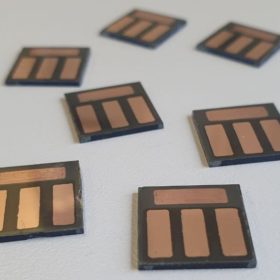
Ethylenediamine increases efficiency of inverted perovskite solar cell by 22%
Scientists in Germany have raised the efficiency of an inverted perovskite solar cell from 15.9% to 20.1% by using a mixed solvent vapor annealing method based on ethylenediamine (EDA).
