
Solar may cover the world’s electricity demand with 0.3% of its land area
An international research group claims that raw materials and land availability do not present a real barrier for a global energy system with solar at its center. They said that forecasts for PV growth should not have their axis on utility-scale power plants and instead consider vertical PV, agrivoltaics, and floating PV as the source of future big market volumes.

Only5mins! – Standards in agrivoltaics might limit innovation
Makoto Tajima, an agrivoltaics analyst for Japan’s Institute for Sustainable Energy Policies (ISEP), speaks to pv magazine about the growth of agricultural PV in Japan, as well as cost considerations and the pace of technological development.
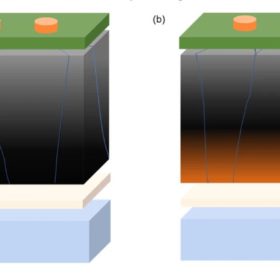
Cadmium selenium telluride solar cell achieves 20% efficiency via bandgap gradient
US scientists have applied bandgap gradient to a cadmium telluride PV cell for the first time. The result is an improvement of its efficiency and open-circuit voltage, and lower non-radiative recombination.
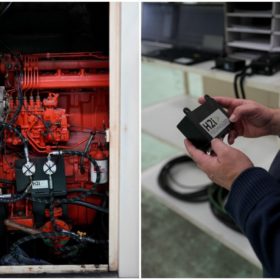
Australian startup develops systems to inject hydrogen into diesel engines
H2i Technology has developed a hydrogen enhancement kit that injects hydrogen into existing diesel engines to reduce diesel use. It is building 10 commercial-ready systems and plans to soon start field testing.
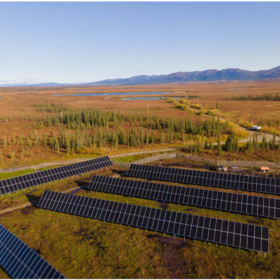
Deploying solar, storage, heat pumps in the Arctic
US researchers have conducted case studies on the successful deployment of distributed renewables in the state of Alaska. In one study, two cities installed 223.5 kW solar PV arrays coupled with 351 kWh batteries and 250 kW inverters, in addition to cold climate heat pumps.
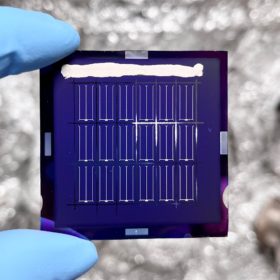
Silver-alloyed CGIS solar cell with 18.7% efficiency
Swiss scientists have used a minimal amount of silver to alloy the absorber in a thin-film CIGS solar cell. They say this process could help to improve efficiency, open-circuit voltage, and fill factor, while compensating for the low bandgap of the CIGS layer.

Australian scientists unveil method to produce hydrogen straight from ocean
University of Adelaide researchers and their international partners have successfully used seawater with no pre-treatment to produce green hydrogen. They did this by introducing an acid layer over the catalysts in situ.
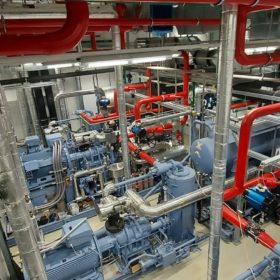
Steam-generating heat pump for industrial applications
The Austrian Institute of Technology (AIT) plans to build a heat pump that generates steam at 184 C at 11 bars without using gas. The tech, which uses natural refrigerants, will be used in the pharmaceutical industry.
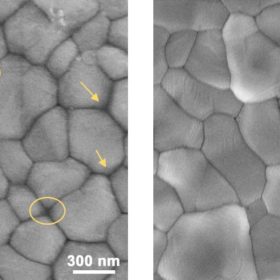
New ‘cushion’ solution to take stress off perovskite solar cells
Scientists in Germany have discovered a polymer compound that, when added to perovskite thin-film precursor materials, wraps itself around the perovskite crystals, acting as a cushion to protect the perovskite structure from thermomechanical stress. They used the additive to fabricate cells with up to 24.6% efficiency, retaining 96% of their initial performance after accelerated testing equivalent to one year in the field.
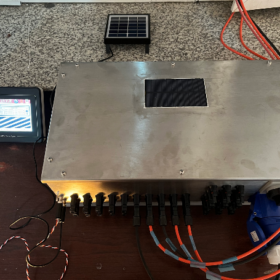
Novel snow-removal tech uses electricity from uncovered PV panels
JA Solar has worked with Chinese scientists to test a new electrical heating system for solar panels that uses the heat from uncovered panels to remove snow. The system starts by using grid electricity, but then relies on the thermal effect of resistance to uniformly heat the whole PN junction area of the snow-covered panels.
