
‘Free-form’ organic PV
French organic PV module manufacturer Armor said it began manufacturing free-form PV modules in early April. The new technology will allow the company’s ASCA PV film to be produced in a range of different shapes.
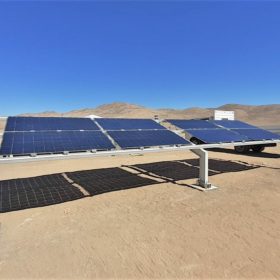
Bifacial panel made in Chile
Atamostec, a private-public initiative supported by Chile’s government-run Production Development Corp. and several industrial partners, has developed a new module. The team claims that the bifacial panel offers an additional annual average gain of 11% compared to monofacial PERC modules with the same cell technology.
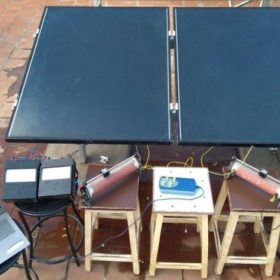
Lowering PV panel temperature with phase change materials
A group of researchers from India is trying to apply a special phase change material to regulate temperature in copper, indium and selenium solar panels. Phase change materials are substances that are capable of storing thermal energy, allowing for the stabilization of temperature.

Solar pavement for outdoor applications
Hungarian tech company Platio has developed solar pavement for outdoor applications in urban environments, homes, office buildings, shopping malls, and public infrastructure projects. The pavement consists of solar tiles that may cost between €50 and €80, depending on the size and characteristics of projects.

Global supergrid vs. regional supergrids
Researchers from Finland’s Lappeenranta University of Technology have assessed the economic advantages of a fully interconnected global network. They found that an international grid could contribute to a global LCOE of €52.50/MWh. The higher complexity of such a system, however, would only be marginally compensated by additional economic benefits.

How much dust is enough?
A U.K. study has identified 13 soiling agents with differing effects on light transmittance. Researchers found some dust particles were able to degrade photovoltaic performance by as much as 98%.
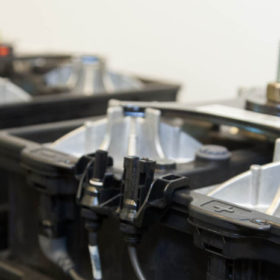
Low-cost bio-inspired electrocatalyst for rechargeable metal-air battery
Indian scientists have developed a low-cost electrocatalyst based on iron, manganese and N-doped carbon derived from fish gills (Fe/Mn/N-FGC) to increase the performance of a homemade rechargeable zinc-air battery. The Fe/Mn/N-FGC cathode-based battery achieved open-circuit voltage of 1.41 V and a large power density of 220 mW/cm2 at 260 mA/cm2 current density – compared to 1.40 V and 158 mW/cm2 for a commercial platinum/carbon-based battery – with almost stable charge-discharge voltage plateaus at high current density.

Australian researchers take solar windows to the next level
The building-integrated PV devices have taken a big leap forward on the back of a partnership between Australian scientists and a major glass manufacturer which will investigate the use of semi-transparent solar cells in commercial applications, potentially revolutionizing building design.

New manufacturing technique for 26%-efficient tandem perovskite solar cell
U.S. scientists have demonstrated a perovskite-silicon tandem cell they claim has low reflectance losses and strong potential for commercial production. The tandem architecture involves a manufacturing process featuring the solution-based blading of perovskites onto textured silicon wafers.

Solar inverters vs. cyberattacks
A U.S. research group is now developing new inverters to protect solar installations from cyberattacks. The researchers also aim to create new cybersecurity standards. Professor Alan Mantooth, the group’s research coordinator, said that inverters can be shut down if they are hacked, or contribute to grid instability and result in the overcharging of batteries, while potentially creating problems that we still don’t know how to address.
