
More than 100 GW of solar in the Netherlands? Possible by 2050
Solar capacity is expected to grow to unthinkable levels in the tiny country, according to a new report by Netbeheer Nederland. Under one scenario in which regional governments and companies would take the lead in the energy transition, cumulative solar capacity could reach 125 GW. Under a second scenario, in which growth would be driven by the central government, total PV capacity could hit 106 GW.
SunPower pauses its solar cell and module factories, reduces salaries and workweek
The solar efficiency leader remains on track to complete its planned split into two independently focused pure-play solar companies by the end of the second quarter.
Germany has 200,000 solar-plus-storage systems
EuPD Research estimates around 65,000 energy storage systems linked to rooftop PV were installed last year thanks to increasingly popular solar arrays and electric vehicles as well as rising electricity prices.
Switzerland provides additional $47m for solar incentives
The government wants to see off a potential slump in the PV market as a result of the Covid-19 pandemic. The increase means CHF376 million worth of rebates will be available for solar systems.
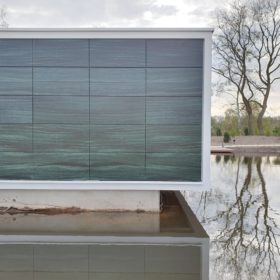
Wood-like solar facades
Taiwanese manufacturer Heliartec Solutions is offering BIPV panels for building facades that can be designed to mimic different kinds of textures in conventional building materials. The panels can also work as colored laminated safety glass and replace traditional cladding in the ventilated facades of buildings. They vary in length from 60 cm to 240 cm, with widths ranging from 30 cm to 120 cm. Depending on their size, the panels can offer power outputs of 90 W to 150 W per square meter.
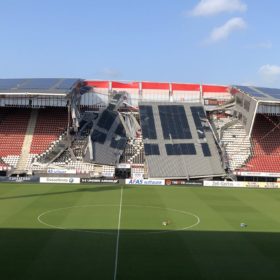
Solar cleared in damages to Dutch football stadium
A failed top rail girder connection was responsible for the 2019 roof collapse at AZ Alkmaar’s football stadium, an investigation by Dutch engineering firm Royal HaskoningDHV has revealed. The collapse was triggered by strong wind loads during a storm.
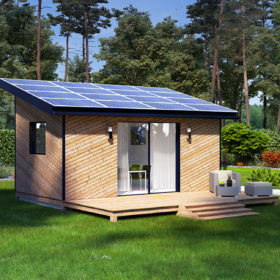
A wooden solar house for €1,700 per square meter
French start-up Solaire Box has raised €1.5 million to back its business supplying wooden houses complete with PV rooftops. The buildings cost €1,700-2,000/m² and feature PV modules made by French firm Systovi. The company plans add to add features such as energy storage systems and carbon-free heating.
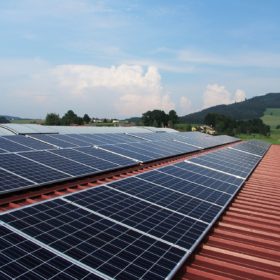
Portugal fast-tracks 30 MW of small solar to help hard-pressed businesses
The Ministry of Environment and Climate Action will permit 220 self-consumption projects with generation capacities of no more than 1 MW to be connected immediately. The usual long-winded permitting process has been side-stepped as the government seeks to enable financially-stricken enterprises to benefit from lower energy bills during the public health crisis.
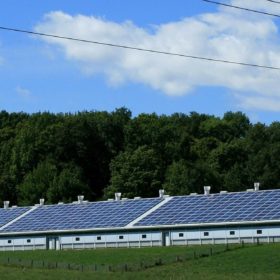
A big grid solution to harness small solar arrays
Scientists at the U.S. National Renewable Energy Laboratory are developing a communication system to coordinate and control the volumes of solar power injected into grids by small scale solar arrays.

The weekend read: Turkish policy turns to the rooftop
Turkey’s stuttering economy, shifting PV policy landscape, and the fruitless YEKA tenders have undermined the country’s solar progress, even though it was considered Europe’s most promising market as recently as two years ago. But its rooftops could still bloom if new regulations that will be issued in May manage to make solar attractive to both businesses and households alike.
