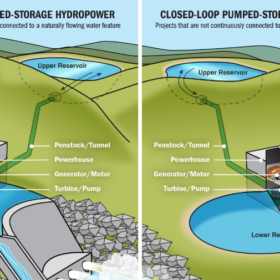
Closed-loop pumped hydro on the rise
Closed-loop pumped-hydro storage offers more chances to minimize environmental effects on water sources and overcomes the problem of finding suitable sites. According to an Australian research team, closed-loop systems could prevail on open-loop systems in the future and this trend is confirmed by another group of scientists from the United States.
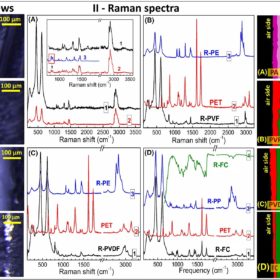
Monitoring near-infrared transmission for a healthy backsheet
Scientists in Germany developed a method to determine the structure and degradation of module backsheets and encapsulants in the field, by analyzing the material’s near infrared light transmission. Applying the theory to a multi-MW PV plant, the group was able to identify four different backsheet types. With further development, the method could be a valuable tool to monitor module degradation in the field and spot faults early on.
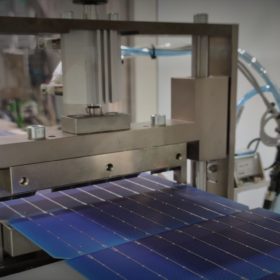
Mondragon Assembly secures licensing deal for continuous string process
Mondragon Assembly’s continuous string process technique is purportedly 10% more productive than a standard stringing machine.

Red BIPV solar module from Italy
The module is available with wattages of 230-245 W and can reach an efficiency of up to 13.45%. The panel is part of a new series of colored products that includes silver and orange modules.
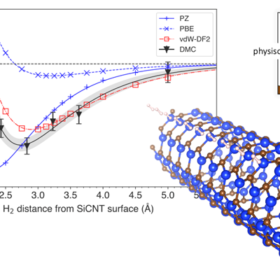
Storing hydrogen with silicon-carbide nanotubes
Storing hydrogen in carbon nanotubes and other nanostructures is still far from reaching commercial maturity. A Japanese research team, however, has developed a new simulation technology that may help better estimate the energy needed to favor the ideal interaction between hydrogen and its storage material.

How much glass is needed for terawatt-scale PV?
German scientists have assessed demand for resources such as glass and silver until 2100 and have found that current tech learning rates could be sufficient to avoid supply concerns.

Invisible BIPV system covers building in Zurich’s city center
The BIPV installation was developed with monocrystalline solar tiles provided by Swiss manufacturer 3S Solar Plus. The product is available in different gradations of green, blue, terracotta and brown and has a power output ranging from 80 to 170 W, depending on color and size.

All-weather imaging tech to detect PV module faults
The system combines software that applies a modulated electric current to the PV panels and an indium-gallium-arsenide (InGaAs) photodiode detector that takes a sequence of images of the panels. According to its creators, the proposed technique works with any lighting conditions and in all weather.
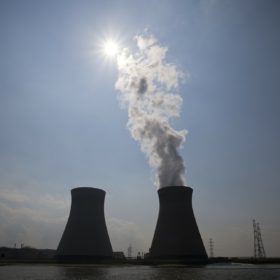
Renewables vs. Nuclear: 256-0
The latest World Nuclear Industry Status Report shows that the world’s operational nuclear capacity grew by just 400 MW in 2020, with generation falling by 4%. By contrast, renewables grew by 256 GW and clean energy production rose by 13%. “Nuclear power is irrelevant in today’s electricity capacity market,” the report’s main author, Mycle Schneider, told pv magazine.
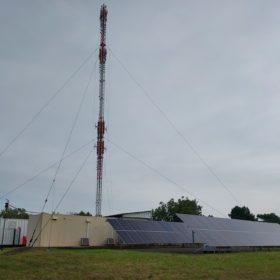
Solar-plus-hydrogen for air traffic control
A 19.8 kW PV system is powering a telecommunications antenna at a French air control center. When it produces more energy than needed, the surplus is used to produce hydrogen which is then utilized to produce new electricity via a fuel cell system and provide power to the antenna during a period of up to five days. For short-term storage, lithium-ion batteries are used.
