Does corona pave the way for a real Green Deal revolution?
Germany will assume the Presidency of the Council of the European Union on July 1 and will be responsible for progressing EU legislation over the next six months.
Sharp unveils black, half-cut-cell module
The solar panel will be part of the half-cut-cell series recently launched by the Japanese manufacturer and the company claims it is ideal for rooftop PV projects with aesthetic requirements. The 19.0%-efficient product has a power output of 320 W.

Coronavirus concerns overshadow PV Expo in Tokyo
The annual trade show was not particularly well-attended this year, but market sentiment is still positive in Japan – nobody believes that installations will drop due to the coronavirus outbreak. And the country’s upstream industry – modules, batteries, and hydrogen tech – clearly remains compelling, given the number of brave souls who actually did make the trip out to Tokyo Big Sight this year.
Half-cut modules from Sharp
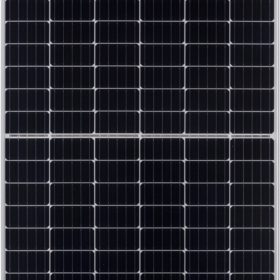
The Japanese electronics giant has unveiled three monocrystalline half-cut cell modules said to provide 2-3% better performance than standard, full cell panels. The claimed efficiency of the modules exceeds 19.5% and Sharp says power output ranges from 330-395 W.
Enel kicks-off production at Italy’s heterojunction module factory
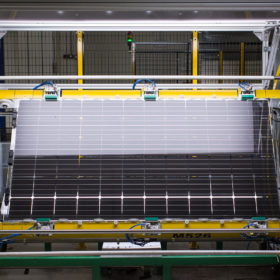
The manufacturing facility, idled a few years ago, will produce bifacial modules. The company claims panel efficiency exceeds 20.5% and the factory has an annual production capacity of around 200 MW.
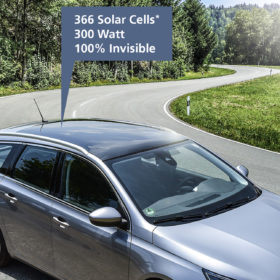
Fraunhofer ISE displays colored solar car roof at auto trade fair
An increasing number of carmakers and research institutes are developing concepts that combine e-mobility and solar. Thus far, range additions from in-car panels of between 10 and 60km are the limit of innovation. The Fraunhofer roof is tinted with a color that hides the cells but lets through most of the light.
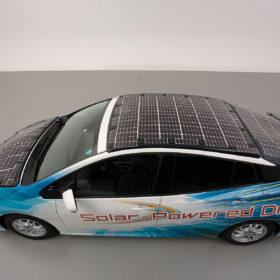
Toyota shows off solar Prius with 860 W output from 34% efficient cells
The car will be road tested at Toyota City in Japan. Solar charging technology for the vehicle will then be further optimized before the vehicle goes on sale.
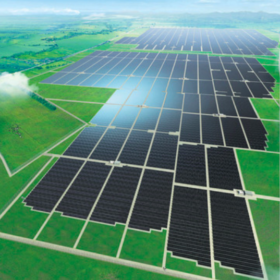
Sharp launches three new mono-PERC modules with 19.1% efficiency
Sharp has released three new high-efficiency mono-PERC solar panels. Ranging from 300 W to 370 W, the five-busbar modules are designed for use in a range of applications, from residential PV projects to large commercial installations.
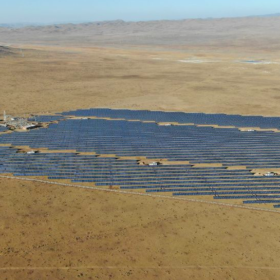
ADB, LEAP to back 15 MW in Mongolia with $18.7m loan
The Asian Development Bank (ADB) and Leading Asia’s Private Infrastructure Fund (LEAP) have agreed to provide an $18.7 million loan to support the development of a 15 MW solar project in Mongolia.

Smart Energy Week in Tokyo: Self-consumption, storage and a plentiful pipeline for now
Though we’re unlikely to see a return to the days of double-figure GW annual installation levels, Japan will stay at the top table of solar. Last week, pv magazine visited PV Expo Japan, part of Tokyo’s World Smart Energy Week, and found plenty of market developments to discuss, along with healthy interest from major players.
