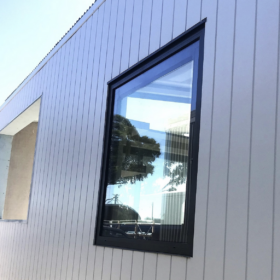
ClearVue unveils Gen3 solar glass with 66% higher energy output
ClearVue Technology says the latest iteration of its solar vision glass delivers more than 66% additional energy output per square metre than its predecessor, while significantly reducing production complexity and costs.
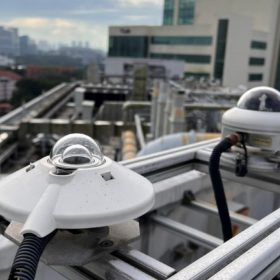
Singapore to adopt solar forecasting model
Scientists have completed a one-year trial of a model that calculates solar irradiation forecasts up to 24 hours in advance. Singapore’s Energy Market Authority now plans to adopt solar irradiance forecasting, as the model has an average error rate below 10% for one-hour forecasts.
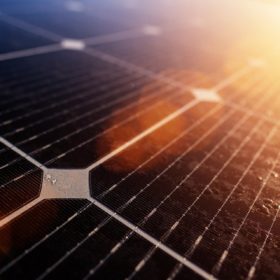
Chinese manufacturer wants 28%-plus efficient HJT perovskite tandem solar cells
Footwear producer Golden Solar announced it would enter the solar market last year, with a focus on heterojunction devices.

Over-irradiance events affect utility scale PV components
Researchers are seeking to understand the extent to which sudden spikes in irradiance can affect solar power plants. The preliminary findings indicate large scale PV projects are not immune to such events, especially when the spikes last longer than a minute.
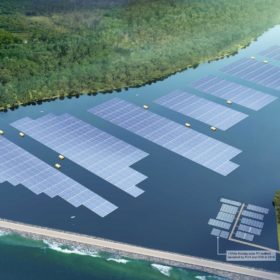
Construction begins on 60 MW floating solar plant in Singapore
The project, on the Tengeh reservoir, will sell power to the city state’s Public Utilities Board under a 25-year power purchase agreement.
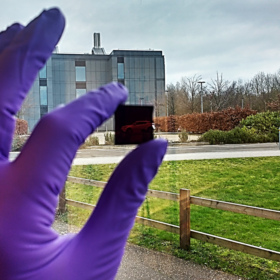
Printed protection for perovskite cells
Scientists led by the University of Cambridge have developed a new method to print a protective layer of copper directly onto a perovskite solar cell, providing protection to the active layer from damage often caused in later production stages. Cells using this layer were tested in various tandem combinations with silicon cells and achieved a maximum efficiency of 24.4%.
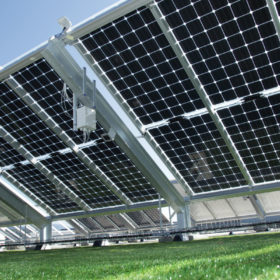
French bifacial standards measure up
A global assessment of bifacial testing methods conducted in Singapore has endorsed the approach taken by France’s Institut National de l’Énergie Solaire.
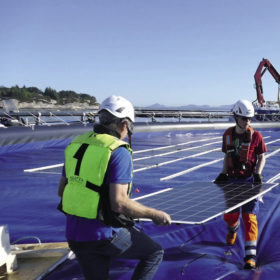
Put your hands on a floating PV system
A new handbook published by the World Bank and Solar Research Institute of Singapore contains advice on how to plan and build floating PV. The guide is intended to help developers with site identification; feasibility studies; finance; environmental and social issues; procurement and construction; and operations and maintenance.
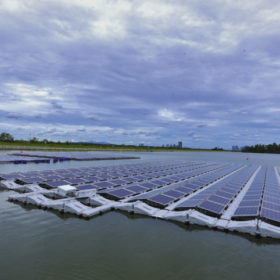
Singapore preps SE Asia’s ‘largest public floating solar tender’
The water authority of the city state wants to procure a 50 MW floating solar installation on the Tengeh Reservoir that will be operational by 2021. Details were revealed today by technical consultant DNV GL.
SERIS aims for 24% efficiency for mono PERC cell
The Singapore research institute will cooperate with China’s Ruxing Technology to increase the efficiency of its monoPoly™ technology. Through this cooperation, SERIS believes its solar cell efficiency could be raised to 24%, and module power beyond 345 W.
