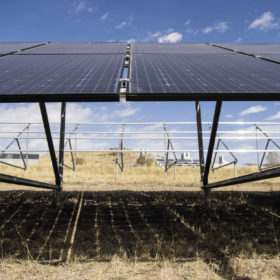
Bifacial PV modules no longer exempt from US Section 201 import tariffs
The U.S. authorities are currently subjecting imported bifacial modules to a 20% penalty – the same tariff applied to almost all other crystalline silicon solar modules.

Hanwha Q Cells unveils special panels for floating PV
The South Korean module manufacturer has developed two new products for large-scale floating PV plants. They have power outputs of 415 W and 420 W and efficiencies of 19.4% and 19.6%.

Long-term assessment of PV panel degradation under hot, humid tropical climates
A Dutch-Hungarian research team has measured, for 12 years, the degradation rates of PV modules installed in an off-grid system located in Ghana. It found that the panels had an average annual decline in power yield of 3.19%.
REC identifies location for 4 GW solar module factory in France
The French National Commission of Public Debate validated, on November 3, the launch of a public consultation on the project initiated by the Norwegian group REC. The chosen location is Hambach, in the northeastern region of Moselle. The planned investment is €680 million.

Indonesia has 18.2 MW of solar under net metering
Most of Indonesia’s deployed capacity comes from industrial PV systems, at 7.7 MW, while residential PV installations stand at just 5.1 MW. The authorities introduced improved net metering provisions earlier this year.
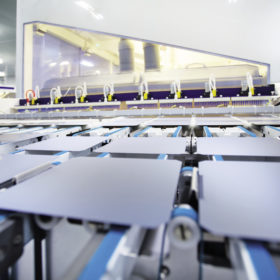
Chinese PV Industry Brief: Longi, Jinko and JA Solar expect their combined capacity of 182mm modules will reach 54 GW next year
At a conference held in Shanghai last week, the three Tier-1 manufacturers explained that the entire Chinese PV industry will continue to adapt to the 182mm wafers over the next months.

More land restrictions for solar in Taiwan
PV developers will no longer be allowed to deploy solar on salt flats in ecologically sensitive areas in Chiayi County and the city of Tainan.
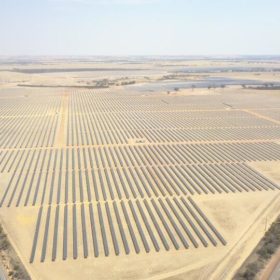
Danish fund backs 5 GW Australian renewable hydrogen project
Copenhagen Infrastructure Partners and Hydrogen Renewables Australia have agreed to develop the 5 GW Murchison Renewable Hydrogen Project in Western Australia. It will use PV and wind to produce hydrogen fuel for export to Japan and South Korea.

Chinese patent office rejects patent nullity proceedings against Hanwha Q Cells
Longi Solar had filed two lawsuits in China against the validity of two patents of the photovoltaic manufacturer from South Korea. Hanwha Q-Cells sees now a good chance of being successful in proceedings before the European Patent Office.
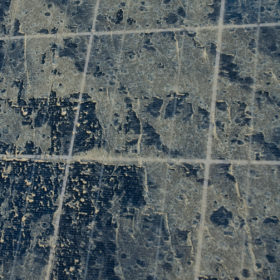
New panel cleaning tech based on nano-coating and mechanical vibration
Researchers in Egypt have tested a new solar module cleaning technique for solar arrays in arid regions. They claim that the combination of nano-coatings with vibration mechanisms on the backs of modules can reduce manual cleaning requirements.
