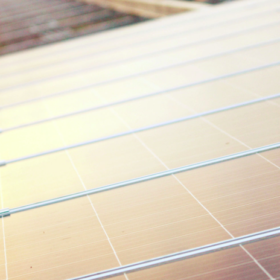
Canadian Solar sees turnover and profits retreat
The Chinese-Canadian manufacturer reported a 1% decrease in sales in the third quarter, with net profit falling 19%, to US$55.2 million. Quarterly shipments were up significantly year on year, from 1.59 GW in July-to-September last year to 2,387 MW this time around. The company expects to ship up to 8.5 GW of panels and achieve turnover of up to US$3.16 billion this year.
IRENA predicts LCOE of solar will drop to $0.01-0.05 by mid century
The latest study published by the International Renewable Energy Agency says the average solar electricity cost of $0.085/kWh produced by projects commissioned last year is set to fall to $0.048 next year, and $0.02-0.08 by 2030.
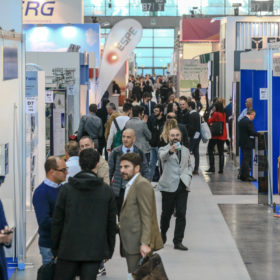
Italy’s struggle to re-join the gigawatt club
Italy’s main solar event, the Key Energy fair held in Rimini, demonstrated the continuing importance of rooftop PV for Italian renewables but also promised a gradual return for large scale solar. Industry insiders are hoping for at least one gigawatt of solar next year, on top of a projected 600 MW this year.

Goa to replace traditional clay tiles with solar ones
State energy minister Nilesh Cabral says householders will be offered the chance to reduce energy bills without any upfront cost by leasing roofspace to installers as part of plans to add 15 MW of solar capacity in Goa by March.
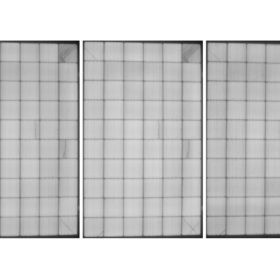
New metallization tech to reduce microcracks in solar cells
A U.S. research group has developed a metal-carbon-nanotube composite – MetZilla – which can be embedded in commercial, screen-printable silver pastes and is said to reduce the formation of hotspots in solar modules and to prolong panel lifespan. The composite metal contacts are also ‘self-healing’ as they are able to regain electrical continuity after cycles of complete electrical failure caused by extreme strain.
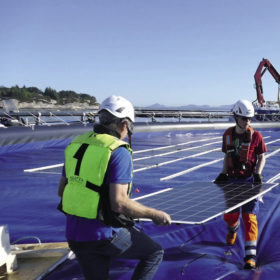
Put your hands on a floating PV system
A new handbook published by the World Bank and Solar Research Institute of Singapore contains advice on how to plan and build floating PV. The guide is intended to help developers with site identification; feasibility studies; finance; environmental and social issues; procurement and construction; and operations and maintenance.
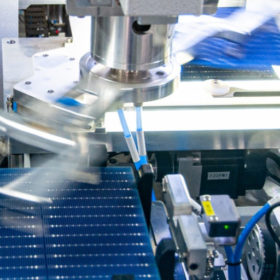
Energetica begins manufacturing at gigafactory in Austria
The module maker has started producing solar modules at its fab in Liebenfels.
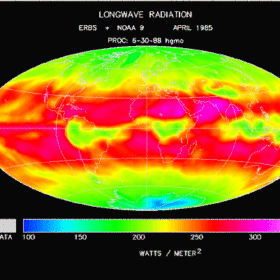
New material for radiative cooling of solar panels
Spanish researchers have discovered a material said to offer radiative cooling and self-cleaning of devices which undergo critical heating during operation, such as PV panels. The thermal emitter enabled the scientists to lower the daytime temperature of silicon wafers by 14 degrees Celsius.

Poland tops 1 GW of solar
Grid operator Polskie Sieci Elektroenergetyczne has published figures demonstrating the country had 1,007.2 MW of solar at the end of September, with 600 MW of new PV coming online in the first nine months of the year. The Polish government expects total capacity to reach 1.3 GW this year.
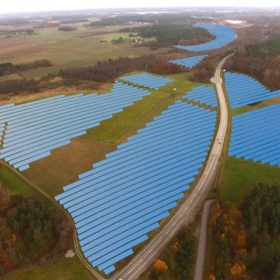
Swedish cooperative goes solar
A 20 MW solar park is planned near a Stockholm highway to generate power for a tenants association. The project is expected to generate cheaper power than grid electricity and will also trade clean energy certificates on the Swedish-Norwegian market.
