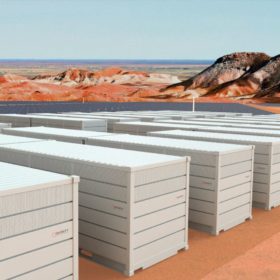
Large-scale vanadium redox flow battery takes shape in Australia
A new South Australian big battery will show the value of diverse storage deployments in the National Electricity Market.
The Hydrogen Stream: More hydrogen for the ports of Rotterdam and Antwerp
Australia and Chile are both granting funds to green hydrogen projects and Denmark is exempting pilot power-to-gas projects from complying with its energy legislation. Furthermore, the Fraunhofer Institute for Applied Polymer Research IAP is working to find solutions for private customers to produce hydrogen.
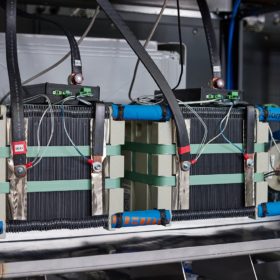
New stack design for cheaper redox flow batteries
German scientists have proposed a new design for stacks used in redox flow batteries. Through a powder-to-roll process, a device that weighs 80% less than a conventional stack was fabricated.

Italy could double PV capacity by 2025, says PI Berlin
International investments in large-scale solar plants, combined with repowering and current support schemes, could trigger a PV boom in Italy, says Germany-based technical advisor PI Berlin.

CNBM wants to set up GW-scale production of CdTe solar panels in China
German PV production equipment provider Singulus will supply the vacuum coating systems for the new production. The Chinese conglomerate currently operates CIGS panel production facilities at four different locations in China.
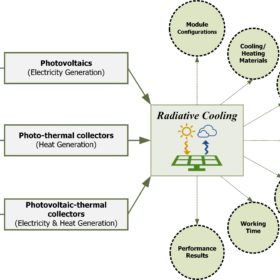
The best radiative cooling tech for PV arrays
Scientists in China have analyzed the radiative cooling techniques used in combination with solar energy systems such as PV arrays, solar thermal collectors, and concentrated PV installations. They identified five major system typologies based on functionality and working time.

Arkolia pairs biogas with self-consumption PV plant
Arkolia has coupled a biogas purification plant in France with a 100 kW rooftop solar array.

Semitransparent selenium solar cell for applications in tandem devices
The bifacial device showed a power conversion efficiency of 5.2% on the front side through an n-type contact and 2.7% on the rear side through a p-type contact.
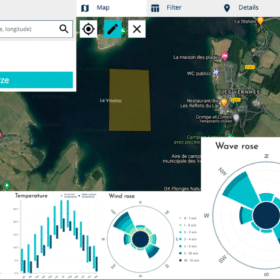
New tech to identify best locations for floating PV
Norway’s Glint Solar and the Norwegian Geotechnical Institute have developed an algorithm that is able to automatically calculate wave heights and wind directions at potential locations for floating PV arrays. It considers the geometry of the water surface as well as 40 years of data on wind conditions.
On-site and off-site community solar options: What’s right for you?
In the second part of a pv magazine series on commercial-scale solar, we look at community solar options as a viable alternative for tenants and owners alike.
