Norwegian solar market sees the light with 366% growth in 2016
Around 11 MW of new PV capacity was installed last year in Norway. The volume of new installations grew by 366% compared to 2015. This growth was mainly driven by the country’s regulation for self-consumption and the green certificate scheme.

Neo Solar Power confirms it will gradually exit polycrystalline production
The Taiwanese solar cell maker has confirmed to pv magazine that it will exit the polycrystalline PV business and will focus on its monocrystalline products. The company intends to gradually lower its polycrystalline PV capacity.

UK installs over 1.94 GW of PV in 2016
The UK installed almost 2 GW of new PV installations in 2016, according to provisional BEIS statistics. The country’s cumulative capacity now surpasses 11.49 GW. The largest increase in capacity during the year was registered in March 2016, before the Renewable Obligation scheme for projects smaller than 5 MWp was closed, with a one-year grace period for some projects.
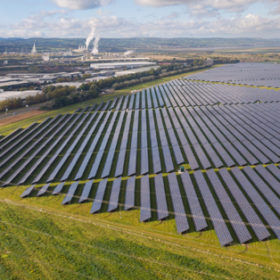
Foresight Solar Fund looks to raise more than GBP 50 million in new investments
The UK based investment group has announced its intention to raise further investments worth more than GBP 50 million (US$ 61.2 million), with the aim of acquiring up to 250 MW of solar power plants in the UK, as well as expanding into South Africa.
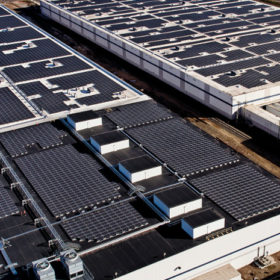
Amazon to install up to 41 MW of on-site solar in the U.S. by the end of 2017
The company’s solar installations planned for 15 fulfillment centers this year will be followed by another 35 by 2020

Extension of EU duties on Chinese solar products is now official
On Friday, the EU published in its Official Journal the 18-month extension of antidumping and anti-subsidy duties on Chinese solar products, including notification of a partial interim review of the measures. The review could lead to the gradual reduction of duties and minimum import prices. The EU will also consider if the Minimum Price Undertaking agreement is still of relevance.
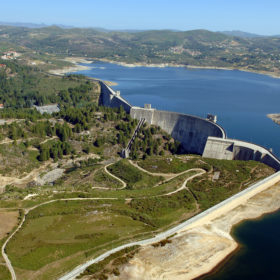
Solar panels for world’s first combined hydro & floating PV project installed in Portugal
French floating PV specialists Ciel & Terre have installed a 220 kW PV installation at a hydroelectric dam on Portugal’s Rabagão River. Though a comparatively small installation, this represents the first time the two technologies have been used in tandem at utility scale.

Rick “Oops” Perry becomes the new U.S. Secretary of Energy
The man who once famously forgot the U.S. Department of Energy in a 2012 Republican presidential debate is now, astonishingly, the person who was just confirmed to lead it.
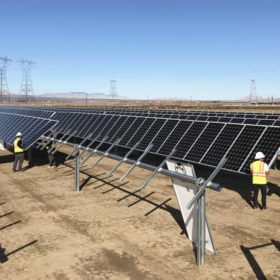
Solar reached 1.4% of U.S. electricity in 2016
The latest figures from the U.S. Department of Energy show that all renewables together made up 15.3% of U.S. generation.
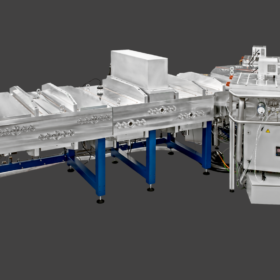
INDEOtec receives PECVD equipment order from Saudi university
The Swiss equipment company will provide its OCTOPUS II PECVD/PVD platform to King Abdullah University of Science and Technology (KAUST) in Saudi Arabia.
