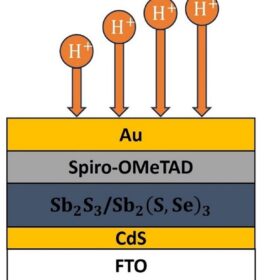
New research shows antimony chalcogenide solar cells are suitable for space use
Researchers in the US tested the degradation of antimony chalcogenide solar cells exposed to proton radiation. The result indicated a robust tolerance and potential for use in space.
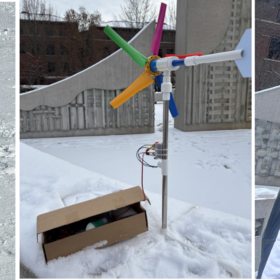
Sodium-ion battery storage for ultra-low temperatures
U.S. researchers have developed a sodium-ion pouch cell that operates reliably at temperatures as low as –100 C. The battery was tested with simulated and real renewable energy sources, including wind and solar, and maintained stable performance in both laboratory and field conditions.
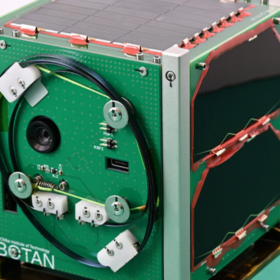
Idemitsu developing CIGS solar modules for satellites
Japan’s oil giant Idemitsu Kosan and U.S.-based Source Energy Company announced a collaboration to develop copper indium gallium-selenide solar modules and arrays for satellite and space applications.
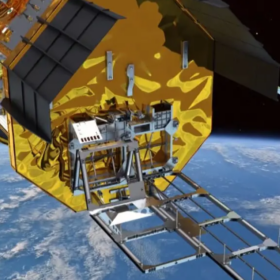
Ricoh developing perovskite solar technology for space, buildings
The Japanese imaging and electronics company said tests of its perovskite solar cell technology will be conducted in a demonstrator system aboard an unmanned cargo spacecraft operated by Japan Aerospace Exploration Agency.

Korean startup developing perovskite-CIGS tandem solar technology for satellites
Flexell Space is planning to put its perovskite-copper indium gallium selenide (CIGS) tandem solar cell technology in-orbit later this year. It has also raised venture capital and signed several collaboration agreements, including a technology transfer with the Korea Institute of Energy Research.
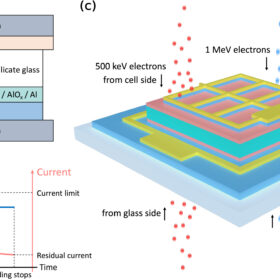
Gallium arsenide solar cells radiation-resilient for space applications
A group led by Cambridge University has developed an adhesive-free method of bonding ultra-thin gallium arsenide solar cells to borosilicate glass. The proposed technique is reportedly compatible with standard planar device processing.
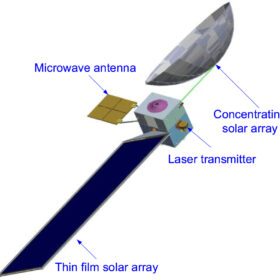
First attempt to design solar power transmission demonstrator
Scientists in China have outlined a mission proposal for the China Academy of Space Technology space solar power (SSP) development program. It includes three solar arrays, microwave power transmission, and laser power transmission. The roadmap predicts this demonstration mission cound be attempted before 2030.
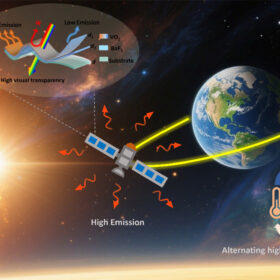
Novel smart coating for space solar cells
Researchers in China have investigated how transparent smart radiation devices (TSRD) can be used to protect space solar cells from extreme thermal fluctuations. Through a series of simulations, they have shown that the proposed technique could become an “effective” solution for spacecraft solar cell thermal management.
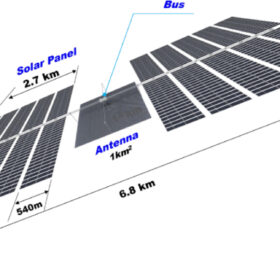
South Korea plans 120 GW space solar project
Two Korean research institutes are designing the 2.2 km × 2.7 km Korean Space Solar Power Satellite project with the aim of providing approximately 1 TWh of electricity to the Earth per year. The proposed system should use 4,000 sub-solar arrays of 10 m × 270 m, made out of thin film roll-out, with a system power efficiency of 13.5%.
Ascent Solar announces 17.55% efficiency for CIGS tech
Ascent Solar, a US-based manufacturer, has achieved an efficiency of 17.55% for its copper, indium, gallium and selenide (CIGS) technology. It says it plans to release a new CIGS solar module with this efficiency rating soon.
