
Oxford PV targets 20-year lifetime for perovskite-silicon tandem modules by 2028
Oxford PV CEO David Ward spoke with pv magazine about the prospects of its company and the perovksite-silicon tandem PV technology at the WFES event in Abu Dhabi. He said Oxford PV is expanding manufacturing beyond Germany while focusing on global licensing partnerships.

JinkoSolar pushes on perovskite-silicon tandem solar with new partnership
JinkoSolar has signed a strategic cooperation agreement with XtalPi, an “AI for Science” platform company, to pursue high-throughput R&D on perovskite-crystalline-silicon tandem solar cells using an AI platform and quantum-physics-based models.

Fraunhofer ISE achieves 30.6% efficiency for perovskite-silicon tandem based on industry-standard bottom TOPCon cell
Researchers at Fraunhofer ISE have developed a perovskite-silicon tandem solar cell using a TOPCon bottom cell with standard textured front surfaces. Their results show that TOPCon bottom cells can perform comparably to heterojunction cells in tandem devices in terms of shunt resistivity, supporting scalable, cost-effective industrial production.

KAUST, Franuhofer ISE announce 33.1%-efficient fully texturized perovskite-silicon tandem solar cell
The fully textured tandem cell achieved an open-circuit voltage of 2.01 V and an “extended” outdoor stability in the Red Sea coast, according to the researchers.

Longi unveils 34.58%-efficient tandem perovskite-silicon solar cell based on asymmetric self-assembled monolayer
In a new scientific paper published in nature, the Chinese manufacturer presented a new tandem perovskite-silicon solar cell based on a bottom cell with a heterojunction design. It also used a new type of self-assembled monolayer that reportedly reduces non-radiative recombination and increases cell efficiency.

Perovskite-silicon tandem solar cell built with hybrid blade coating achieves 27.8% efficiency
The King Abdullah University of Science and Technology and the Fraunhofer Institute for Solar Energy Systems report producing perovskite-silicon tandem solar cells with open-circuit voltages exceeding 1.9 V as the result of a two-step hybrid evaporated/blade-coated process for perovskite films.

GCL achieves 29.51% efficiency for perovskite-silicon tandem module
GCL Optoelectronics has achieved 29.51% efficiency for its perovskite-silicon tandem solar module, with the result certified by China’s National Institute of Metrology.
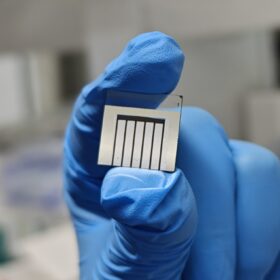
Perovksite-TOPCon tandem solar cell based on self-assembled monolayer achieves 31.1% efficiency
Researchers in China have fabricated a perovskite-TOPCon solar cell with a top perovskite device utilizing a self-assembled monolayer aimed to improved cell stability. The tandem cell achieved a high fill factor and a certified efficiency of 30.9%.
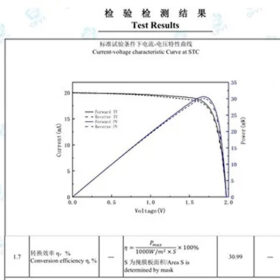
Risen claims 30.99% efficiency for perovskite-silicon tandem solar cell
The result was confirmed by China’s National Solar Photovoltaic Product Quality Supervision and Inspection Center. The tandem device is relying on a bottom cell based on a heterojunction design.
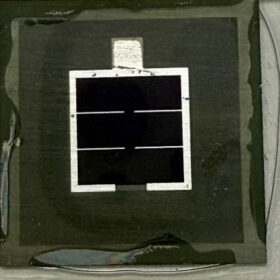
Taiwanese researchers unveil 31.5%-efficient perovskite-silicon tandem solar cell
The cell utilizes a heterojunction device as the bottom cell and a perovskite top cell integrating a hole transport layer made of nickel(II) oxide and methyl-substituted carbazole.
