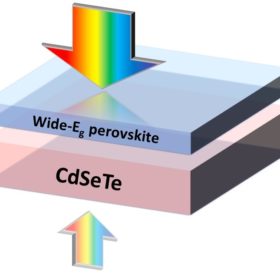
Bifacial tandem perovskite-CdSeTe solar cell with 20% efficiency
Developed by U.S. scientists, the cell is claimed to achieve an equivalent bifacial efficiency of more than 20% with an open-circuit voltage of more than 2 V. The choice of the bifacial architecture is intended at increasing the device’s power yield in order to offset the high costs for producing the CdSeTe sub-cell.
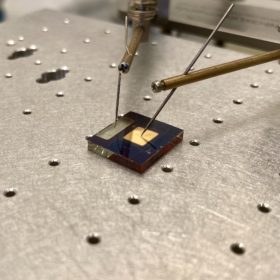
Cadmium sulfide, a poor partner for selenium tandem solar cells
A Danish-German research team has shown that using cadmium sulfide as an n-type partner in heterojunction tandem solar cells based on selenium does not produce satisfying results. The team has discouraged other scientists from following the same path.
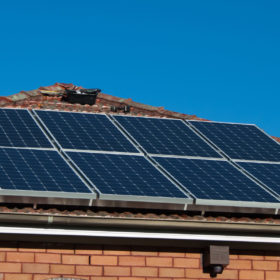
PV system design for low-cost hot water production
Developed by Spanish scientists, the proposed system design is said to be able to achieve water temperatures above 70 degrees Celsius and to cover around 85% of the annual sanitary hot water consumption of a household with six people.
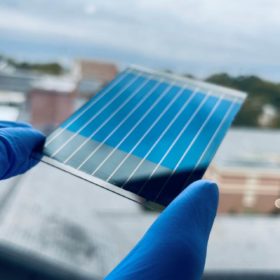
Lead-absorbing encapsulation for 18.5%-efficient mini perovskite solar module
The solar module has an area of 31.5cm2 and is relying on perovskite cells with an efficiency of 22.9%. It was encapsulated with a special ionogel that is claimed to enhance the module’s impact resistivity and stability, as well as to reduce the possibility of lead leakage.
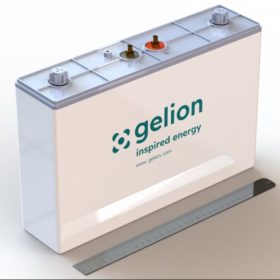
Zinc-bromide battery for stationary energy storage from Australia
Australian startup Gelion is seeking to commercialize a non-flow zinc-bromide battery based on a stable gel replacing a flowing electrolyte. According to the manufacturer, the device is safe, robust and recyclable.
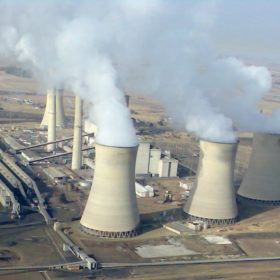
South Africa gets $8.5 billion to phase out coal, boost renewables
The funds should be allocated through multilateral and bilateral grants, concessional loans, guarantees and private investments. A task force will now seek to identify initial sources of financing for the electricity and coal mining sectors, as well as financing options for the development of electromobility and green hydrogen.
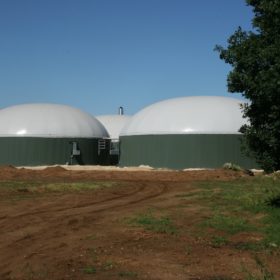
The Hydrogen Stream: The world’s first high-purity hydrogen from biogas
Austrian researchers have demonstrated a chemical looping system can be retrofitted into biogas plants. It is said the new tech can produce high-purity hydrogen for fuel cells on an industrial scale. The scientists concerned said their system could produce hydrogen, on a decentralized basis, for €5/kg.
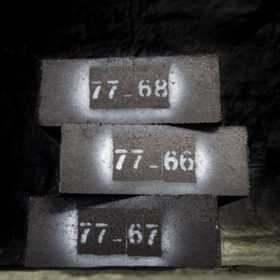
Storing renewable energy with thermal blocks made of aluminum, graphite
Newcastle University engineers have patented a thermal storage material that can store large amounts of renewable energy as heat for long periods. MGA Thermal is now manufacturing the thermal energy storage blocks as storage for large-scale solar systems and to repurpose coal-fired power stations.
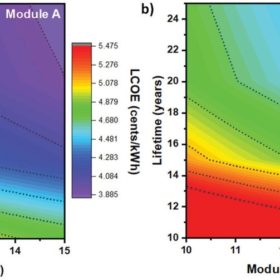
Analyzing the opportunity for perovskite solar module production in India
Scientists in India conducted a techno-economic analysis for a 100 MW production line for carbon-electrode perovskite solar modules, located in Himachal Pradesh, India. The analysis concludes that, even at the smaller scale, this emerging technology could achieve cost levels comparable with today’s silicon solar products.
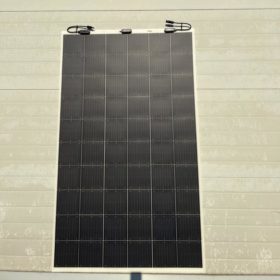
Flexible BIPV panel with 410 W output from Italy
Developed by cleantech company Verditek, the flexible module has a 20.1% efficiency and a weight of 4.9kg. It can bend up to 35% using standard 160µ-thick crystalline cells.
