
Canadian Solar law suit settlement approved
The Ontario-based solar company will pay US$13 million to settle a class action filed in August 2010, after the Ontario Superior Court approved the offer.

US ‘aqueous air battery’ developer reveals investors in recent $76 million funding round
The holy grail of energy storage has always been low-cost and long-duration. Form Energy plans to deploy a 1 MW/150 MWh system with a Minnesota utility before 2023 – an unprecedented energy storage duration, if successful.
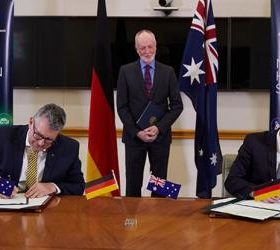
Work begins on German-Australian ‘hydrogen bridge’
Australia and Germany have officially started a joint-feasibility study on green hydrogen production and trade, or what the German Federal Minister of Research has described as a “hydrogen bridge.”

pv magazine video: US storage market under spotlight
In pv magazine’s second roundtable session, Advanced technologies, the U.S. storage market came under the spotlight – in particular, the lessons that can be learned from solar as the market moves towards greater maturity. Also under discussion was the trend among PV manufacturers to producing ever larger cells and modules in the continuous drive to bring down LCOE. But is big necessarily better?

EU says Netherlands must pay €659m for evading anti-dumping duties on solar panels
The Netherlands has allegedly evaded anti-dumping and countervailing duties imposed on solar imports from China, Taiwan and Malaysia between May 2015 and March 2017, according to the European Commission. The Dutch government said the claims from Brussels are not justified.
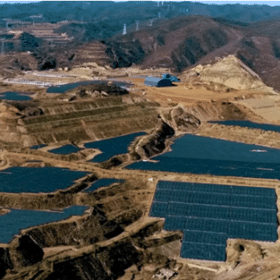
Chinese coal mine hosts 300 MW solar plant
TBEA New Energy’s new solar park relies on flexible mounting systems and large-gradient, large-span slope support technology.
India tweaks 100 MW solar-plus-storage tender
The peak DC capacity of the project has been reduced, along with the size of the battery storage element of the facility.
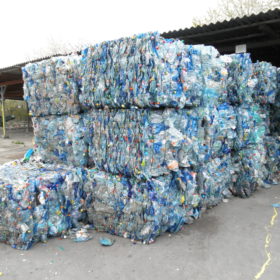
New process to recover PET and EVA from recycled solar panels
Researchers in China are proposing a new technique to recover polyethylene glycol terephthalate (PET) and ethylene-vinyl acetate (EVA) in solar panels at the end of their lifecycle. The two materials represent around 15% of the total material in a wasted solar cell, with a share of 10% for EVA and 5% for PET, respectively.
China could drive 4.2 TW of solar capacity by 2050 under decarbonization plan
The solar and wind industries could benefit from a $6.4 trillion boom under the most ambitious of two scenarios described by Bloomberg New Energy Finance, and $2.4 trillion even in the business-as-usual outlook.

Self-cleaning tech for small off-grid PV arrays
A U.S.-Pakistan research group has created a new self-cleaning mechanism for standalone PV systems up to 5 kW in size. The system increases power yields by around 35%, while its payback period is estimated at around five years.
