
Panasonic to exit solar manufacturing
The Japanese brand will continue to sell third-party-made modules under its brand in its home market, as it already does overseas, but in-house PV wafer, cell and module production will halt by the end of fiscal year 2022.
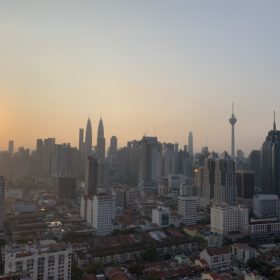
Malaysia to allocate another 500 MW of rooftop PV under net metering
The NEM 3.0 program will run until the end of 2023 and will see the participation of residential, commercial and industrial prosumers as well as public entities and government ministries.

France publishes first-quarter FITs for PV systems up to 100 kW
The feed-in tariff granted reduces each quarter, in line with how much solar capacity was installed in the previous three-month period.

Dual passivation tech for 20.14%-efficient perovskite solar cell
Europium ions have been used by Chinese researchers to passivate both the perovskite and electron transport layer (ETL) films of a MAPbI3 perovskite solar cell. As a result, the device’s efficiency was raised by approximately 1.5%. The dual passivation approach also achieved an increase in the cell’s fill factor and open-circuit voltage.
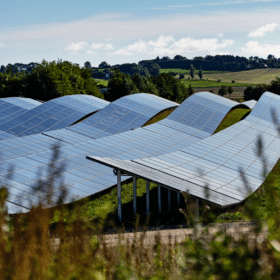
Seven-year PPA for 34 MW solar park in Denmark
Denmark’s Better Energy is building the PV facility in Denmark’s southernmost region. Danish pharmaceutical company Lundbeck has agreed to buy the power generated by the plant over a seven-year period.
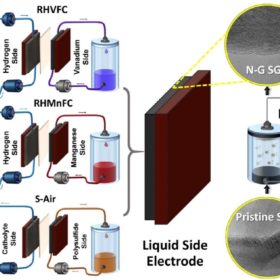
Hybrid electrodes for cheaper redox flow batteries
UK researchers have used standard carbon paper electrodes modified with electrophoretically deposited nitrogen-doped graphene (N-G) to improve the electrochemical performance of hybrid redox flow cells utilized in redox flow batteries. According to their findings, these electrodes are capable of meeting the harsh electrochemical requirements for these HRFCs and offer enhanced performance and operability.
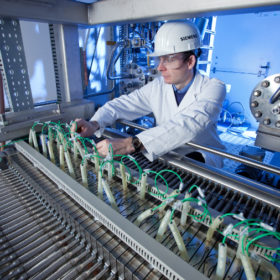
Australian-wide network of 13 clusters to spur hydrogen economy established
National Energy Resources Australia has actioned its instructions from the 2019 National Hydrogen Strategy by investing an initial $1.75 million in 13 regional clusters across all states and territories designed to establish Australia’s global identity in hydrogen technology and expertise.
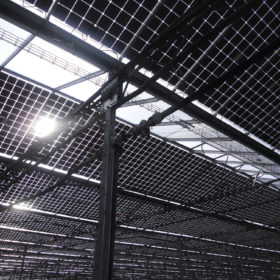
Boosting bifacial panel efficiency with albedo ground covers: Field test results
Tests by 7X Energy show that ground cover material showed promise, but projects will likely still need to prove the long-term durability, degradation rates, and validation of installation labor and O&M.

The weekend read: KSA reforms, but will PV prosper?
Long-term observers of solar deployment in Saudi Arabia can point to almost a decade of disappointment. But that is not to say that no progress has been made, and regional renewables champion ACWA Power has built a solid track record. Indeed, recent reforms to the national utility may give rise to new hopes.
Flexible heat pumps ideal for power grids congested by solar and wind
Dutch transmission system operator Tennet, which also serves Germany, is planning to create flexible electricity demand and reduce grid congestion by promoting the use of smarter heating systems and heat pumps that can also be powered by solar and wind energy. According to its experts, intelligent control of heat pumps may result in the creation of between 0.5 and 1 GW of temporary grid flexibility by 2030.
