Silver accounts for 10% of PV module costs


The share of silver in PV module costs has risen by around 5% in recent months to account for approximately 10% of the total, according to U.S.-based analyst Matt Watson.
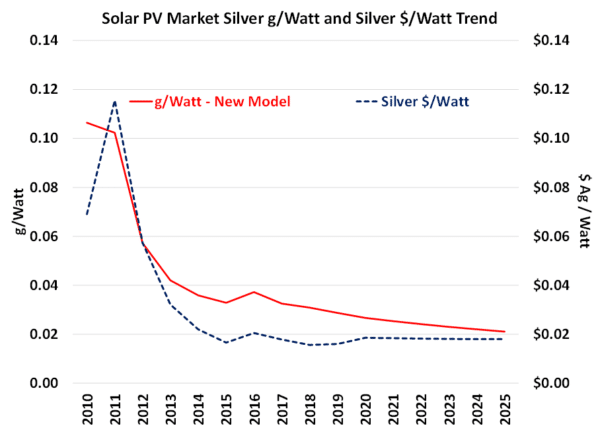
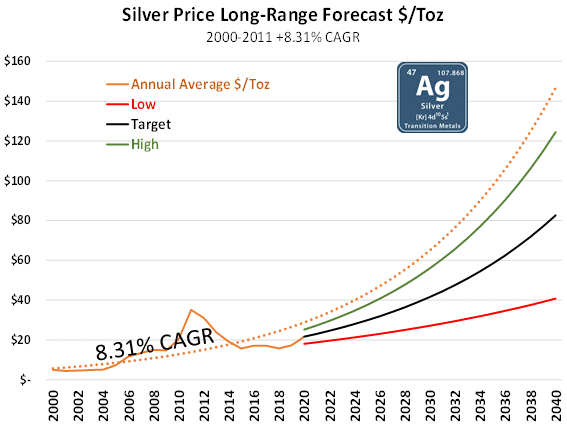
“With PV module costs in the neighborhood of $0.018-$0.019/watt and silver representing around 10% of the overall module cost structure, and module and cell prices still declining, finding a means to lower the silver cost component is going to become an increasingly difficult task,” Watson told pv magazine. “Over the past 20 years, silver has averaged an 8.31% year-on-year growth in prices, which is greater than the current rate of design thrifting. This means lowering that silver $/watt component is going to be very difficult.”
Watson noted that silver is now sold at around $26 per ounce, but said that prices will continue to climb.
“When you study the silver market, electronics demand, led by the Solar PV markets, all have increasingly larger forecast demand,” he said, noting that silver is becoming more of an industrial metal with each passing year. “The projected solar PV module silver cost per watt produced is leveling out going forward as a result of these silver price climbs … As other cell and module costs decline, silver will consume an even larger percentage of the overall module cost as these trends continue.”
Watson, a former executive at U.S.-based CIGS solar module manufacturer SoloPower, is currently the CEO and founder of California-based Precious Metals Commodity Management LLC. He said he believes that the PV industry will probably not move away quickly from the use of silver, despite the recent jump in silver prices.
“In my career, I did extensive work on alternatives alloys without any real success,” he said. “Life testing and electrical efficiency losses always brought us back to silver alloys.”
Watson said that engineering teams use precious metals in electronics for a reason.
“Silver of course is the most conductive mineral in the world, with good corrosion resistance properties assisting the durability of the module,” he added.
He acknowledged that nickel alloy has the potential to replace silver in solar cell metallization, but not in the space of a few years.
“We may need a couple of decades to get there,” he said, noting that in the connector market, copper and copper-nickel alloys are commonly used for both durability and electrical performance
In 2025, when around 230 GW of new capacity is expected, the industry will need 156 Moz, or 15% of the global silver supply.
“And this considering all of the silver design thrifting baselines,” Watson said. “With the growth in other electronics applications, I’m sure the real silver supply continuity pinch point is around 30% of the global silver supply. But at present course, we will hit that 30% silver demand level by around 2046.”
On the current solar PV market growth trajectory, by 2050 some 332 Moz of silver will be needed to support 1.33 TW/year of new installations.
“Clean energy voices calling for an even steeper growth in solar PV, to as high as 3 TWs to 4 TWs a year by 2050,” Watson concluded. “This trajectory of growth would break the silver market without substantial mining growth.”
This content is protected by copyright and may not be reused. If you want to cooperate with us and would like to reuse some of our content, please contact: [email protected].

Please login to comment

[…] feasible to continue using silver in the panels even as silver prices are likely to increase. The cost of the silver used in a panel was around 10% of the total cost of the panel last year. In other words, if silver […]
[…] feasible to continue using silver in the panels even as silver prices are likely to increase. The cost of the silver used in a panel was around 10% of the total cost of the panel last year. In other words, if silver […]
[…] feasible to continue using silver in the panels even as silver prices are likely to increase. The cost of the silver used in a panel was around 10% of the total cost of the panel last year. In other words, if silver […]
[…] dans les panneaux même si les prix de l’argent sont susceptibles d’augmenter. La coût de l’argent utilisé dans un panneau représentait environ 10 % du coût total du panneau l’année […]
[…] pv magazine:Silver accounts for 10% of PV module costs […]
[…] for Solar Energy Systems ISE have been seeking for several years to reduce silver usage — a main concern for the PV industry — in the metallization of TOPCon solar cells, for which relying on lower […]
[…] overall global demand for silver is expected to grow 8% year-on-year to reach 111.2 billion ounces in 2022, according to U.S.-based […]
[…] overall global demand for silver is expected to grow 8% year-on-year to reach 111.2 billion ounces in 2022, according to U.S.-based […]
[…] module factories, as it requires no changes to the tabbing and stringing of the products. In a recent interview with pv magazine, US analyst Matthew Watson said that the share of silver in PV module costs […]
[…] module factories, as it requires no changes to the tabbing and stringing of the products.In a recent interview with pv magazine, US analyst Matthew Watson said that the share of silver in PV module costs […]
[…] Udio srebra u ukupnim troškovima PV modula porastao je posljednjih mjeseci za oko pet posto i čini približno 10 posto od ukupnog iznosa, kaže američki analitičar Matthew Watson. Srebro se sada prodaje cijeni od oko 26 dolara po unci, ali cijene će i dalje rasti i na kraju će činiti još veći postotak ukupnih troškova modula. Pronalazak načina za smanjenje komponente troškova srebra postat će sve teži… Pročitaj više […]
[…] Source: PV Magazine, “Silver accounts for 10% of PV module costs”, March 4, 2021 […]