
Saudi Arabia’s second PV tender draws world record low bid of $0.0104/kWh
The record low price was offered for the 600 MW Al Shuaiba PV IP project, which competed in the second round of the country’s procurement scheme for renewable energies.
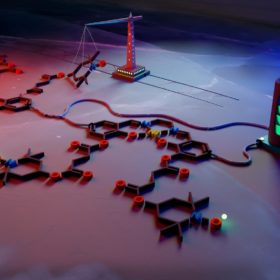
Nickel-salen for a battery that charges in 10 seconds
Scientists in Russia introduce a promising new material for battery energy storage, the product of more than three years of research. Incorporating a nickel-salen polymer into the cathode, the group demonstrated a battery that can charge and discharge ten times faster than today’s lithium-ion batteries. And though the battery still lags in terms of overall capacity, the group is confident that its discovery will lead to big improvements for lithium batteries.
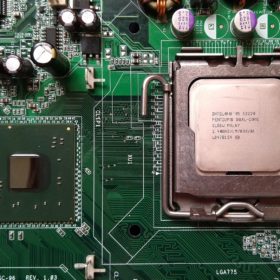
PV rides through semiconductor chip shortage
Many industry sectors across the world are currently being hit by a semiconductor chip shortage as major manufacturers are unable to meet demand. According to Cormac Gilligan, an associate director at IHS Markit, solar and energy storage manufacturers are being less affected. In general, the solar and energy storage industries have learned lessons from being impacted by semiconductor components, for example, transistors, capacitors and resistors in prior years, Gilligan told pv magazine.

Chinese solar company highlights credit downgrades of state-owned entities
A record number of defaults last year has spooked some lenders, according to Solargiga, but the solar manufacturer has announced ambitious plans to ramp production capacity this year and next.
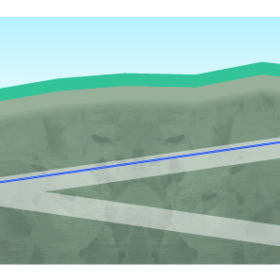
Work begins on green hydrogen storage cavern in Sweden
Vattenfall, SSAB and LKAB are building a rock cavern storage facility in a coastal city in northern Sweden. The 100-cubic-meter facility will be built 30 meters below ground and will begin storing green hydrogen next year.
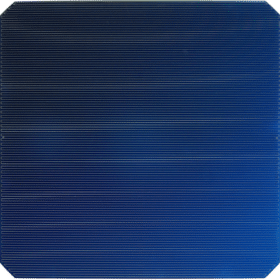
P-type TOPCon solar cell with 21.2% efficiency
Fraunhofer ISE scientists have identified the best metallization pastes to help reduce contact resistivity and contact recombination in p-type TOPCon solar cells. They applied a silicon nitride layer through plasma-enhanced chemical vapor deposition onto both sides of a cell.

Taiwan joins the gigafactory club
Taiwan Cement is planning to build a US$352 million EV battery factory in southern Taiwan. The 1.8 GW facility will produce high-charge-discharge nickel ternary batteries.

India extends manufacturing incentive program to solar modules
A national production-linked incentive scheme introduced to encourage domestic manufacturing will now encompass solar. The PV policy will reportedly offer increased rewards for the production of more efficient panels and for Indian content–although it is not clear how.
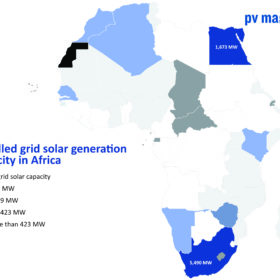
Qair begins construction on 30 MW of solar in Chad
The renewable energy unit of the Total group expects to energize two solar parks next year.

EDF bags PPA for 20 MW solar park from French railway operator
Construction on the solar plant is expected to begin this year. It will supply power to SNCF’s unit SNCF Energie over a 20-year period.
