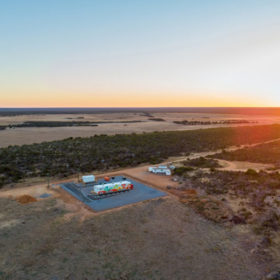
Australian town to be powered by pumped-hydro microgrid
The town of Walpole on Western Australia’s southernmost tip will soon be powered by a pumped-hydro microgrid, a first for the state which is already renowned for its rollout of microgrids and distributed renewable solutions.
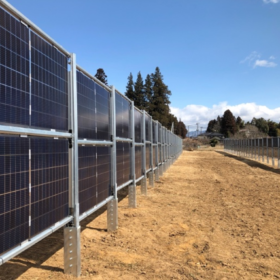
Japan’s first vertical agrivoltaic project
The facility was built with heterojunction modules and mounting systems provided by German companies Luxor Solar and Next2Sun, respectively. The distance between the panel rows ranges from 8 to 10 meters and the agricultural surface within the rows will be utilized by local livestock farmers as pasture.
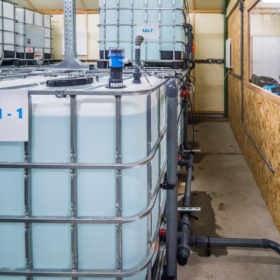
Long-duration storage solution based on saltwater
Developed by Dutch start-up AquaBattery, the storage technology is claimed to independently amend power and energy capacity. The battery system utilizes three storage tanks, one with fresh water, one with concentrated salt water and one with diluted salt water, and also relies on membrane stacks.
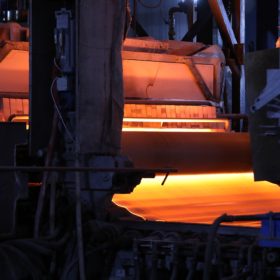
Borosil Renewables to acquire Europe’s largest solar glass maker Interfloat Group
Indian group Borosil Renewables is acquiring Europe’s largest solar glass manufacturer. With major sites in Germany and Liechtenstein, Borosil plans to increase manufacturing capacity to 2,600 tonnes per day, making it possible to supply solar glass for more than 15 GW of PV modules from 2025.
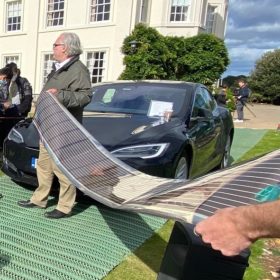
Printed solar panels for Tesla’s journey around Australia
Commercially printed solar cell technology developed by the University of Newcastle is being put to the test to power an electric vehicle’s 15,097-kilometre journey around the entire coastline of Australia.
PV in the Circular Economy: Modeling tool helps predict flow of solar materials
PV ICE uses the latest data from the solar industry to model the flow of PV materials over the next several decades, helping to predict the effects of different market trends, technological developments, and government policies.

Auditor of solar developer issues disclaimer on 2021 figures
As reported by pv magazine, BDO was not permitted access to the paperwork on 11 solar project companies sold by Shunfeng International in 2020 and, therefore, could not offer an opinion on the financial prospects of the business based on last year’s performance either, given the lack of comparative numbers.

The usual crumbs for solar in British energy strategy focusing on North Sea oil and gas
A mixture of home-grown fossil fuels, possibly including fracked shale gas; clean power; nuclear; hydrogen; and smarter grids, apparently in that order, will make up the UK’s proposed energy security response in the wake of Russia’s invasion of Ukraine.

Indonesia’s Riau Islands set for more big solar and storage
Developers are moving fast to meet Singapore’s clean energy needs by establishing overseas solar-plus-storage plants, with a strong focus on facilities in neighboring Indonesia.
New method for long-term prediction of renewables generation in Europe
Developed by scientists in Spain, the new methodology is claimed to be capable of mitigating energy crises in Europe through climate predictions.
