German manufacturer unveils 10 kWh residential redox flow battery

From pv magazine Germany
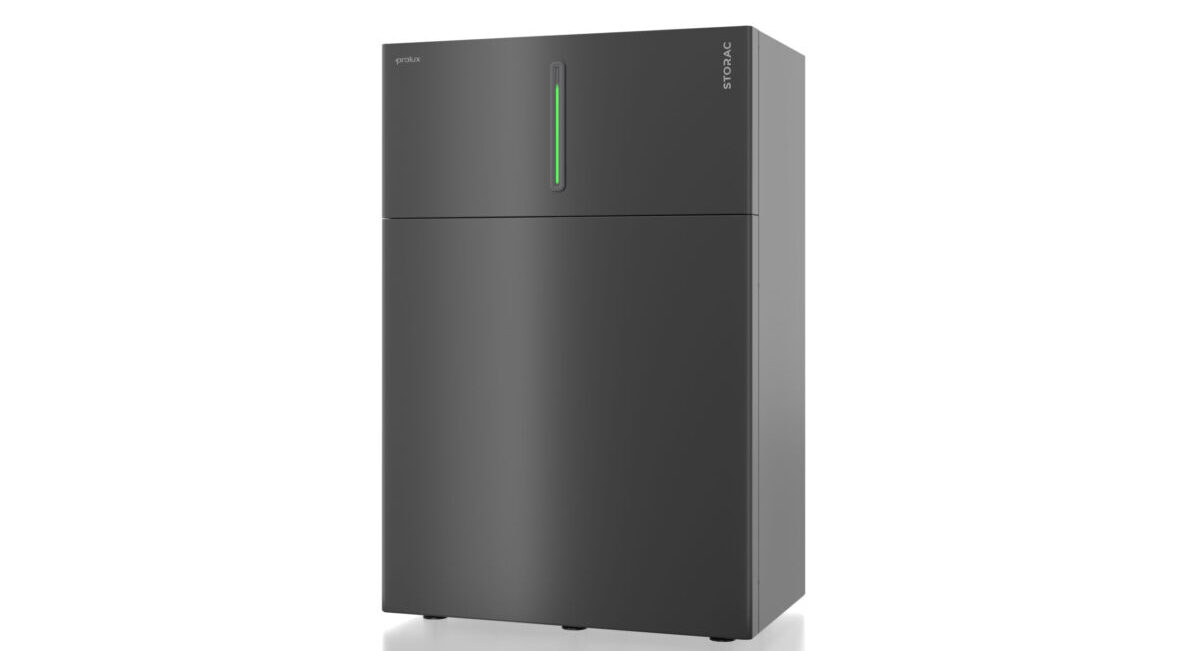
German redox flow battery manufacturer Prolux Solutions, a unit of Swiss building supplier Arbonia, has developed a new residential storage system with a capacity of 10 kWh.
It claims that the STORAC 4/10 battery has a charging and discharging capacity of 4 kW and a peak power of 5 kW. It is designed to be coupled with PV systems in homes with a high consumption profile.
The AC-coupled storage device can provide emergency power and can be cascaded. Its depth of discharge is 100%, according to the manufacturer. The battery features a Modbus RTU (RS485) interface and does not use rare earth minerals, says the company. It reportedly consists of easily recyclable metal and plastic.
Prolux Solutions says that all components can be repaired indefinitely. It notes that the vanadium electrolyte also retains at least 95% of its capacity, even after 20 years, so it can be reused indefinitely.
The company develops its storage systems in Germany and manufactures them in Stribro, Czech Republic. The plant has up to 700 employees.
This content is protected by copyright and may not be reused. If you want to cooperate with us and would like to reuse some of our content, please contact: [email protected].

Please login to comment

you are absolutely right.

In RSA, electricity supply is increasingly problematic. Energy storage (battery) is the most expensive product in acquiring a Solar System (Inverter, solar panels and battery). Available batteries have a predicted useful life of 6000 cycles.
The Redox Flow battery would be a game changer especially if the price is reasonable.

10kwh is useless, 100-200kwh should be fine for home and ev. I use in home around 30kwh/day + another 30kwh for car. Soon I should have another ev. Last a few days was very sunny. I had over 80khw from pv. If I’m in work I can’t use this energy in home, so I have to pay at night for charging. Now I have 15kwh battery and before 12 is full.

10 kWh is the lower end of the range. Good enough for small homes. Flow batteries are scalable upwards to the capacity range that you need. You will need to have PV panels above that capacity.

[…] a Red Dot Award: Design 2023-at és az Award Design Plus powered by ISH 2023-at), a PV Magazine szúrta ki, hogy a cég piacra dobja ezt a konstrukciót. Ráadásul olyan „kiszerelésben”, hogy az […]

Is the battery “stackable” to 30kWhrs?

So it’s not 10kw.. I use rack mount 48v 100ah lithium batteries. I do my thing and it’s better and more cost effective than what’s on the retail market. I do it for financial reasons and not for any religion.

14kwh of EVE LF280K cells (16ea, 280ah, 3.2v) cost around $2000-$3000 presently.
hopefully the price on this flow battery isnt insane.
The vanadium electrolyte is said to be highly corrosive.