Battery prices down 14% this year, says BloombergNEF

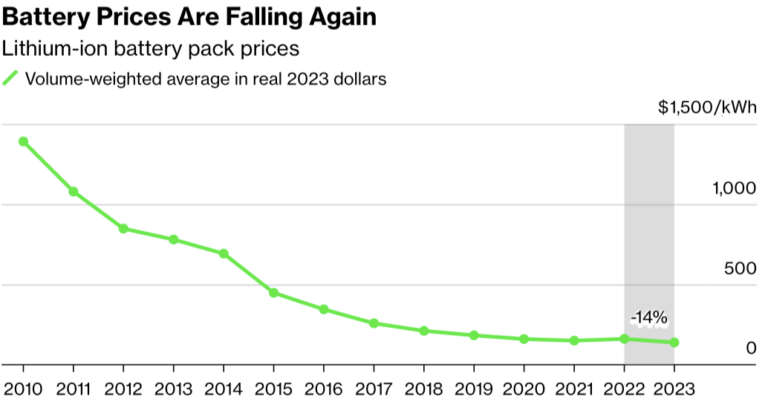
BloombergNEF said in its latest annual study on lithium-ion batteries that the average price of battery packs has fallen this year to $139/kWh, or 14% less than the average of $161/kWh in 2022.
To calculate this average price, BNEF conducted more than 300 surveys among buyers and sellers of lithium-ion batteries for electric passenger vehicles, commercial vehicles, buses, two- and three-wheeled vehicles, and energy storage applications.
Prices vary by sector: Chinese electric buses and commercial vehicles have the lowest prices at $100/kWh. The average price of packs for fully electric passenger cars was $128/kWh.
“However, the story behind this price decrease is somewhat different from previous years,” the analysts said. While the main cause of falling battery prices has historically been technological innovation, this year the price drop is mainly attributed to reduced raw material costs.
Prices for key battery metals, especially lithium, have fallen sharply since January, due to significant growth in production capacity in all parts of the battery value chain, from raw materials and components to cells and battery packs.
Although demand continued to increase year on year, the pace of growth in some electric vehicle markets slowed in the second half of the year, mainly due to increased financing costs and economic uncertainty. On the other hand, battery production in China alone exceeded global demand.
As for the future, BNEF’s energy storage team expects prices to closely follow the trajectory of raw material prices. “We project that pack costs will fall to $133/kWh next year in real terms in 2023,” said BNEF. “In the long term, if the learning pace of the previous year is maintained, battery prices will fall below $100 /kWh in 2027.”
BNEF said that local battery manufacturing in regions such as the United States and Europe can drive up prices in the short term due to the price of energy, equipment, land and labor in these regions compared to Asia.
“However, as the industry matures, these costs could end up falling,” it said.
This content is protected by copyright and may not be reused. If you want to cooperate with us and would like to reuse some of our content, please contact: [email protected].

Please login to comment

[…] lithium-ion battery prices have this year returned to a downward trajectory, the interest in promising sodium-ion batteries […]
[…] lithium-ion battery prices have this year returned to a downward trajectory, the interest in promising sodium-ion batteries […]
[…] 来源:www.pv-magazine.com […]
[…] From pv magazine global […]
[…] von pv magazine Global […]
[…] power outages. Diesel generators have long been the first choice for backup power, but with a drop in the cost of batteries and considerations of fuel costs and maintenance for generators, batteries are becoming a more […]