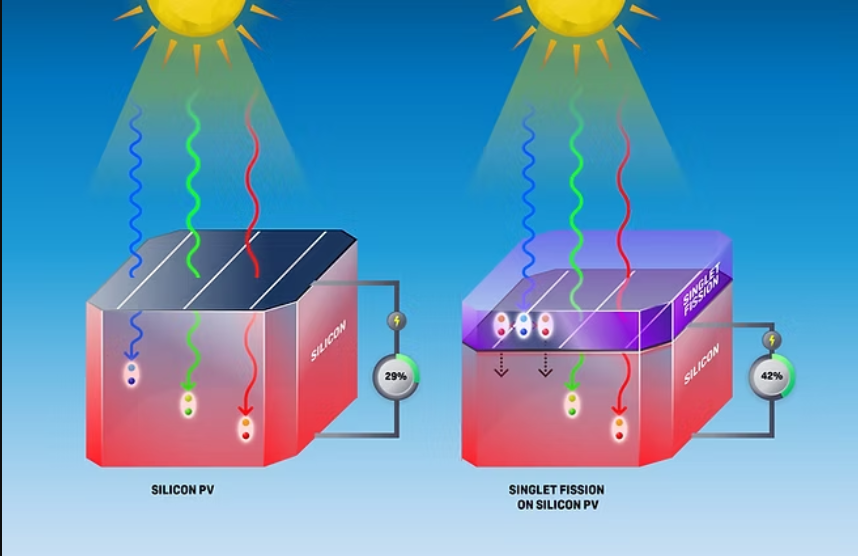





Researchers at the University of New South Wales (UNSW) School of Photovoltaic and Renewable Energy Engineering (SPREE) have filed patent protection and are working to scale production of a new class of molecules that can boost silicon solar cell efficiency, reduce heat, and extend panel lifetimes using singlet fission.
The team’s findings, published in ACS Energy Letters under the title Singlet Fission c-Si Solar Cells: Beyond Tetracene, report success using a robust, photostable molecule called dipyrrolonaphthyridinedione (DPND) and confirm the commercial benefits for singlet fission.
Professor Ned Ekins-Daukes, lead researcher at UNSW SPREE, said the new class of stable organic molecules has the potential to increase energy conversion efficiencies.
“Crucially, we’ve developed a practical pathway to higher output silicon solar cells, without the cost and complexity of tandems, that industry can now trial,” Ekins-Daukes said.
DPND, a relatively stable dye, has been used for the first time to augment the number of carriers in silicon for solar cells.
“Silicon modules today typically achieve 20% to 25% efficiency. Singlet fission could lift that figure beyond 30%, meaning fewer panels are needed for the same energy output, lowering balance-of-system costs and opening applications in space-constrained rooftops, electric vehicles, and building-integrated photovoltaics,” the researchers said.
“By harvesting energy that would otherwise turn to heat, singlet fission reduces silicon cell operating temperatures. Lab and modeling studies suggest panels could run 2.4 degrees Celsius cooler, extending lifetime by around 4.5 years, which lowers replacement costs and increases the value of long-term power purchase agreements.”
They added that singlet fission on silicon solar cells can be built on existing technologies with minimal changes to the architecture.
Unlike most current solar cells, which convert one absorbed photon into a single electron-hole pair, singlet fission allows one high-energy photon to generate two excited electron-hole pairs, effectively doubling the electrical yield from the bluest part of the solar spectrum.
The research says the use of singlet fission molecules on silicon solar cells could increase energy conversion efficiencies from 29% to 42%.
Recent work by the team, published in Nature Chemistry in 2024, shows how photoluminescence emitted from singlet fission is linked to the underlying molecular process. The researchers said light emitted can be used to monitor the process, creating a diagnostic for materials development and quality control in PV manufacturing.
UNSW SPREE Associate Professor Murad Tayebjee said it is now possible to read the light signatures of singlet fission with unprecedented clarity.
“This opens the door to discovering and optimizing a wide range of new materials that could one day boost the efficiency of silicon solar cells,” Tayebjee said.
The research has been supported by the Australian Renewable Energy Agency’s (ARENA) Transformative Research Accelerating Commercialisation (TRAC008) program, with AUD 4.8 million (USD 3.1 million) in funding to help bridge the gap between lab demonstrations and commercial adoption.
Industry partners include Jinko Solar, JA Solar, LONGi, Canadian Solar, DASolar, Leadmicro, Jollywood and Xinhao New Energy.
Dr. Jessica Yajie Jiang, senior research fellow at UNSW SPREE, said the attraction for manufacturers is clear.
“More energy from the same module materials, plus cooler running that extends lifetime,” Jiang said. “We’re now moving from elegant science to practical solar products — and the impact for industry, investors and the environment could be profound.”
This content is protected by copyright and may not be reused. If you want to cooperate with us and would like to reuse some of our content, please contact: editors@pv-magazine.com.

By submitting this form you agree to pv magazine using your data for the purposes of publishing your comment.
Your personal data will only be disclosed or otherwise transmitted to third parties for the purposes of spam filtering or if this is necessary for technical maintenance of the website. Any other transfer to third parties will not take place unless this is justified on the basis of applicable data protection regulations or if pv magazine is legally obliged to do so.
You may revoke this consent at any time with effect for the future, in which case your personal data will be deleted immediately. Otherwise, your data will be deleted if pv magazine has processed your request or the purpose of data storage is fulfilled.
Further information on data privacy can be found in our Data Protection Policy.