Research out of Montreal’s Concordia University suggests that tying them together from the ground up (literally) could be the most effective approach to “green” a city.
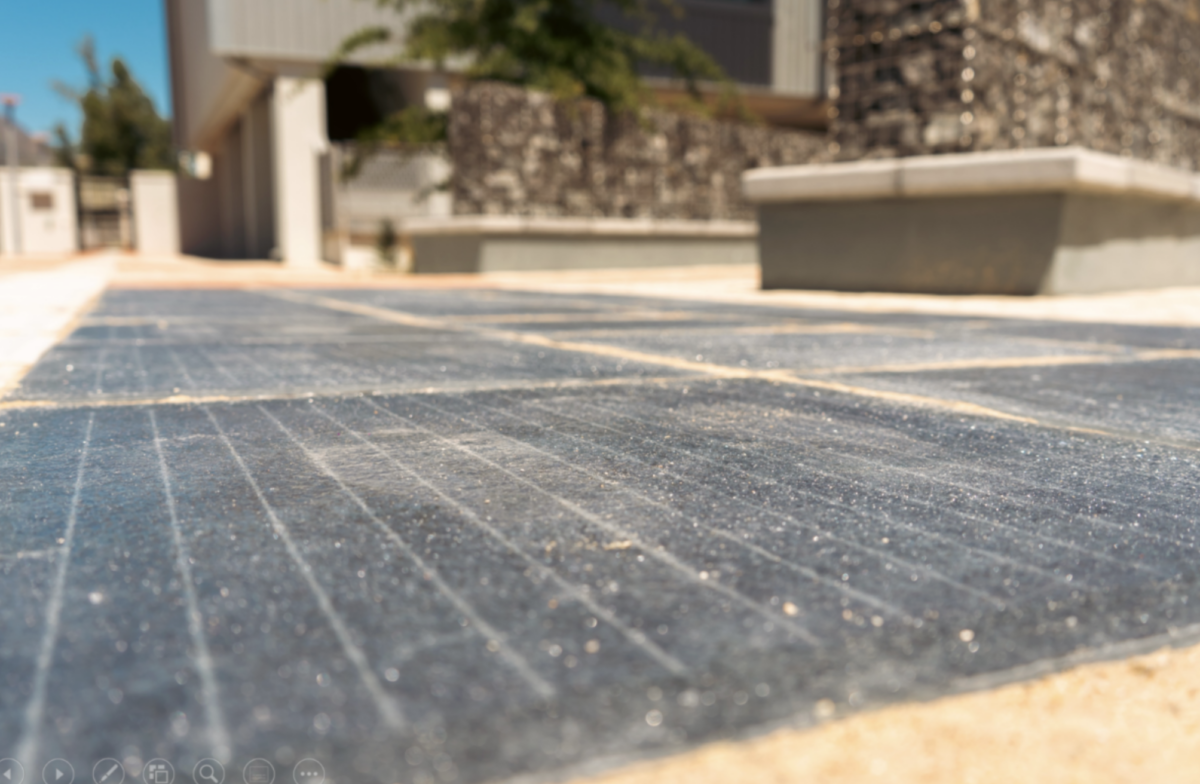
The study, published in Sustainability, posits solar as the backbone of green urban logistics by laying out a framework based on sidewalk-embedded photovoltaic panels that power local, electric vehicle-based delivery networks and food logistics. Rooftops, small lots and other “traditional” solar sites are instead used for community gardens and crop productions.
Under the 15-minute city model, grocery stores, farmers markets and community gardens are evenly spread throughout a neighborhood so that the majority of residents live within a kilometer of fresh, healthy food.
“We want to see how we can integrate energy, mobility, land use and social functions to bring daily needs closer to residents so they can reduce the number of fossil-fuel-consuming trips,” said corresponding author Caroline Hachem-Vermette, an associate professor of building, civil and environmental engineering at Concordia University, in a statement.
Researchers used the West 5 smart community in London, Ontario, as a case study to evaluate how space, emissions, economics, land use and solar performance interact in hopes of creating a model for other municipalities to follow.
The research primarily focuses on the impacts of the sidewalk PV panels, which are embedded in high-traffic pedestrian pathways and measure approximately 600 mm by 600 mm squares that can produce 100 watts at 15% efficiency.
For the studied neighborhood, annual solar irradiation averages 3.69 kWh/m²/day or the equivalent of 286 sunny days per year, which enables just 98 m² of sidewalk PV to produce enough energy to power the entire urban mobility system and slash emissions by 98 percent compared to the fossil-powered base case.
The researchers point out that though the footprint can be small, it can have large impacts. Dedicating just 13.8 percent of roof area, 10 percent of facades, and 15 percent of lot space to vegetable crops rather than solar makes the cluster self-sufficient in certain vegetables like leafy greens or tomatoes. In practice, the model works almost like a distributed form of agrivoltaics by framing PV as the connective tissue linking energy, mobility, land use and food security rather than just a building-only resource.








By submitting this form you agree to pv magazine using your data for the purposes of publishing your comment.
Your personal data will only be disclosed or otherwise transmitted to third parties for the purposes of spam filtering or if this is necessary for technical maintenance of the website. Any other transfer to third parties will not take place unless this is justified on the basis of applicable data protection regulations or if pv magazine is legally obliged to do so.
You may revoke this consent at any time with effect for the future, in which case your personal data will be deleted immediately. Otherwise, your data will be deleted if pv magazine has processed your request or the purpose of data storage is fulfilled.
Further information on data privacy can be found in our Data Protection Policy.