




An international research team has investigated the formation of cemented soiling on PV panels operating under the hyper-arid conditions of the region with the world's highest solar radiation levels, the Atacama Desert in northern Chile, and has found that annual energy losses, if not addressed, may reach up to 9.8%.
The novelty of the research work consisted of shifting the focus from analyzing the impact of non-cemented dust on PV performance to cemented soiling, which the scientists described as a factor with increasing relevance in hyper-arid environments.
The difference between the two soiling types is given by the stronger or weaker bond to the module surface. Cemented soiling is bonded due to moisture, organic material, or chemical reactions, and is difficult to remove with simple rain or light cleaning, while non-cemented soiling is commonly created by dust, sand, or light debris and can be washed away easily by rain or mild cleaning.
“The novelty of this study lies in its integrated approach: it combines long-term real-field monitoring at the Atacama Desert, one of the most extreme PV exposure environments worldwide, with accelerated laboratory experiments that replicate cementation processes under controlled conditions,” the research team explained.
The outdoor tests were conducted at the Atacama Desert Solar Platform (PSDA) run by the Antofagasta Center for Energetic Development (CDEA) at the University of Antofagasta (UA), while the indoor soiling tests were performed at a laboratory of France's National Solar Energy Institute (INES) – a division of the French Alternative Energies and Atomic Energy Commission (CEA).
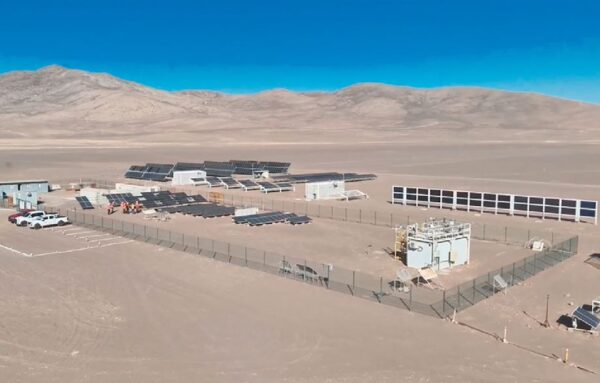
Image: Universidad de Antofagasta, Renewable Energy, CC BY 4.0
For the outdoor tests, the scientists used north-oriented PV glass coupons measuring 4 cm × 6 cm mounted in triplicate on active PV modules with a 20° tilt angle. Different samples were removed and analyzed after 2 days, 1 week, 1, 2, and 3 months, with soiling features being assessed via morphological, elemental, and structural analyses.
PV performance was measured with two calibrated Si reference photocells (Si-V-10TC-T) installed at the same tilt angle and orientation as the benchmark modules. One reference cell was cleaned daily, while the other was left uncleaned.
They also conducted a techno-economic analysis to estimate soiling-related losses and cleaning cost-effectiveness, assuming the operation of a 1 MW PV plant using monofacial crystalline silicon technology.
For the indoor testing, the researchers used a custom environmental chamber to control temperature and relative humidity, as well as data loggers for the PV system monitoring. Artificial soiling was generated via a dust dispenser, with the PV glass samples and mini-modules being mounted on a tiltable plate that was heated and cooled to reproduce realistic gradients.
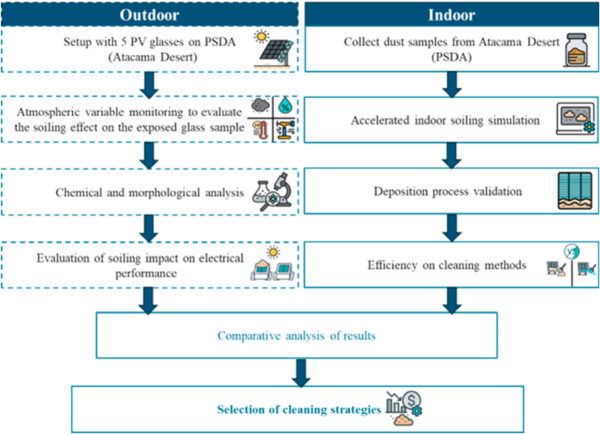
Image: Universidad de Antofagasta, Renewable Energy, CC BY 4.0
The outdoor analysis showed that, under a linear accumulation model, soiling may reduce power yield by up to 9.8% or $93,800 per MW per year in the simulated power plant.
The indoor tests demonstrated that dry cleaning is effective in restoring the original PV module performance, although it does not completely remove the cemented particles, which leaves behind residues that act as crystallization nuclei.
“These residual traces promote new cementation cycles under favorable environmental conditions, increasing material adhesion in subsequent events,” the scientists explained. “This cumulative effect complicates future maintenance tasks and reinforces the need to select cleaning strategies that restore optical performance and minimize nucleation and deposit evolution over time.”
They also emphasized that wet cleaning should be preferable, despite its higher operational costs and the low water availability in the region.
Their findings are available in the study “Soiling in the Atacama Desert: Impacts on solar performance and evaluation of cleaning techniques,” published in Renewable Energy. The research group included scientists from Chile's Corporación Atamostec, Spain's University of Granada, and Université Grenoble Alpes in France.
“These findings extend beyond the Atacama context, offering a transferable methodology for studying and mitigating cementation-driven soiling in other arid and semi-arid regions,” they concluded.
Atacama has become Chile's and Latin America's largest solar energy hub, with dozens of large-scale utility solar plants having come online there during the past decade. It has exceptional conditions for producing solar power, and effectively, the solar power installed capacity in this region represents more than 90% of the total installed capacity in Chile.
This content is protected by copyright and may not be reused. If you want to cooperate with us and would like to reuse some of our content, please contact: editors@pv-magazine.com.


By submitting this form you agree to pv magazine using your data for the purposes of publishing your comment.
Your personal data will only be disclosed or otherwise transmitted to third parties for the purposes of spam filtering or if this is necessary for technical maintenance of the website. Any other transfer to third parties will not take place unless this is justified on the basis of applicable data protection regulations or if pv magazine is legally obliged to do so.
You may revoke this consent at any time with effect for the future, in which case your personal data will be deleted immediately. Otherwise, your data will be deleted if pv magazine has processed your request or the purpose of data storage is fulfilled.
Further information on data privacy can be found in our Data Protection Policy.