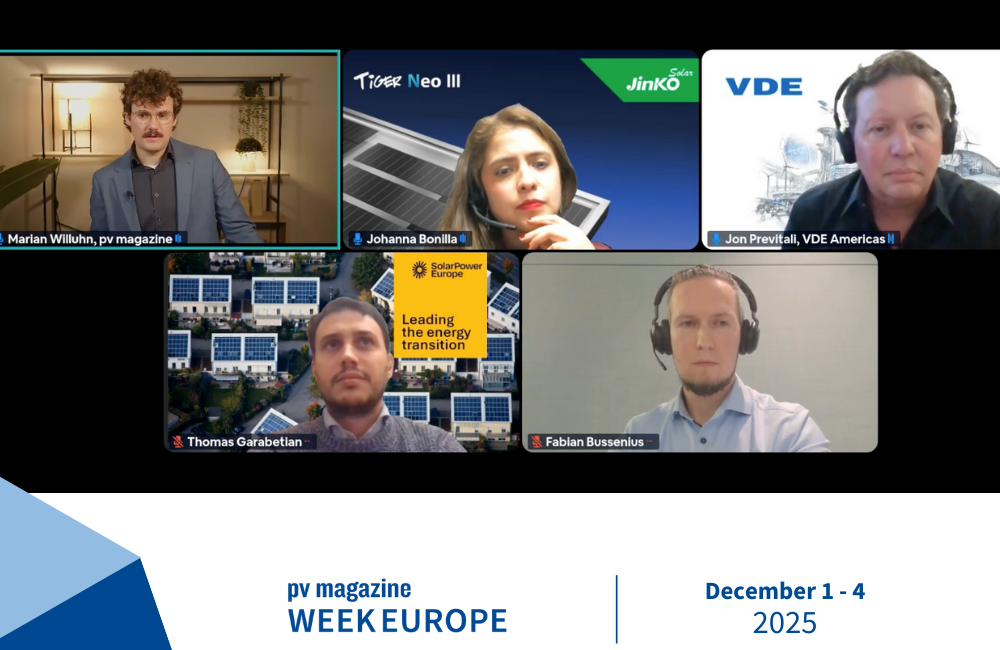





Manufacturers are working to address the impact of ultraviolet-induced degradation (UVID) on TOPCon cells, according to a webinar held as part of pv magazine Week Europe 2025.
Analysis during a session on module quality and risk held as part of pv magazine’s virtual conference last week highlighted growing concerns around UVID on n-type TOPCon solar modules as a hot topic in the industry. Recent research from Australia and the United States found UVID is a major factor that can impact cell performance.
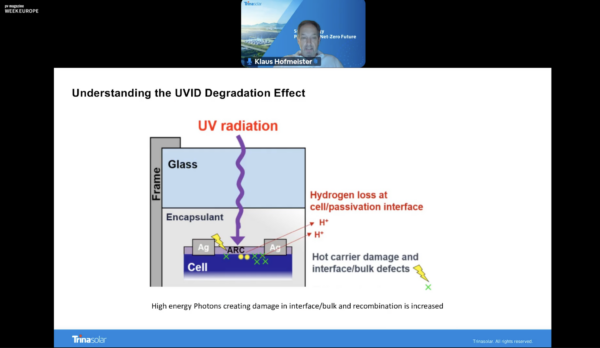
Klaus Hofmeister, product marketing manager at Trina Solar, told attendees the company has developed its own iTopcon technology to mitigate the risk.
“The key lies in the passivation stack on the front side of the cell,” he explained. “By designing a proper passivation stack with all the layers which are included, we can reduce the impact of the high energy photons. And we can limit the damage done to the interface layer and to the passivation itself.”
Hofmeister went on to share Trina’s internal test data and third party test data certified by the China General Certification Centre that has demonstrated “the protection actually works on the module level in real time [and] real-life application.”
“I think nobody needs to be afraid that UVID is a process killer or a technology killer within the TOPCon industry,” Hofmeister added.
Hofmeister also said the measures that can be taken to prevent or reduce UVID are known across the industry. “I cannot speak for all the others, but I hope and I would wish that everybody’s doing it. Then we don’t need to talk about this problem in a few years.”
The webinar also covered the impact of hail events, which are increasing in severity and frequency as a result of climate change.
Thomas Weber, senior project manager at Kiwa PI Berlin, told attendees he believes “the big headaches are still ahead of us when it comes to glass breakage.”
He said that design processes are not reflecting the fact that glass has become a load-bearing element in solar and that current testing methods are failing to prevent breakage.
“We urgently need new standards, practical, module supply agreement criteria, production test protocols, lifetime testing and possibly strength verification of PV glass similar to requirements in the construction industry,” Weber added.
During a panel discussion on hail and module risk, Jon Previtali, VP and senior principal engineer at VDE Americas, shared that hail is already “a huge problem” in the United States, with around $600 million in hail losses over the last few years.
“It’s definitely important to test beyond the IEC standards to test the full range of hail impact that could occur in the field,” Previtali recommended, before highlighting Italy, the Balkan coast and eastern Spain as potential hotspots for hail damage in Europe.
Thomas Garabeitian, head of innovation and research at SolarPower Europe, said there has been “a bit of a wake-up call on the impact of hail on PV” in Europe following incidents in Italy in 2023. “It was in the mind of people around here that hail was a risk but a risk is a bit hard to feel until it really materialized,” he said. “And this is typically the type of thing we are trying to address.”
This content is protected by copyright and may not be reused. If you want to cooperate with us and would like to reuse some of our content, please contact: editors@pv-magazine.com.


By submitting this form you agree to pv magazine using your data for the purposes of publishing your comment.
Your personal data will only be disclosed or otherwise transmitted to third parties for the purposes of spam filtering or if this is necessary for technical maintenance of the website. Any other transfer to third parties will not take place unless this is justified on the basis of applicable data protection regulations or if pv magazine is legally obliged to do so.
You may revoke this consent at any time with effect for the future, in which case your personal data will be deleted immediately. Otherwise, your data will be deleted if pv magazine has processed your request or the purpose of data storage is fulfilled.
Further information on data privacy can be found in our Data Protection Policy.