




From ESS News
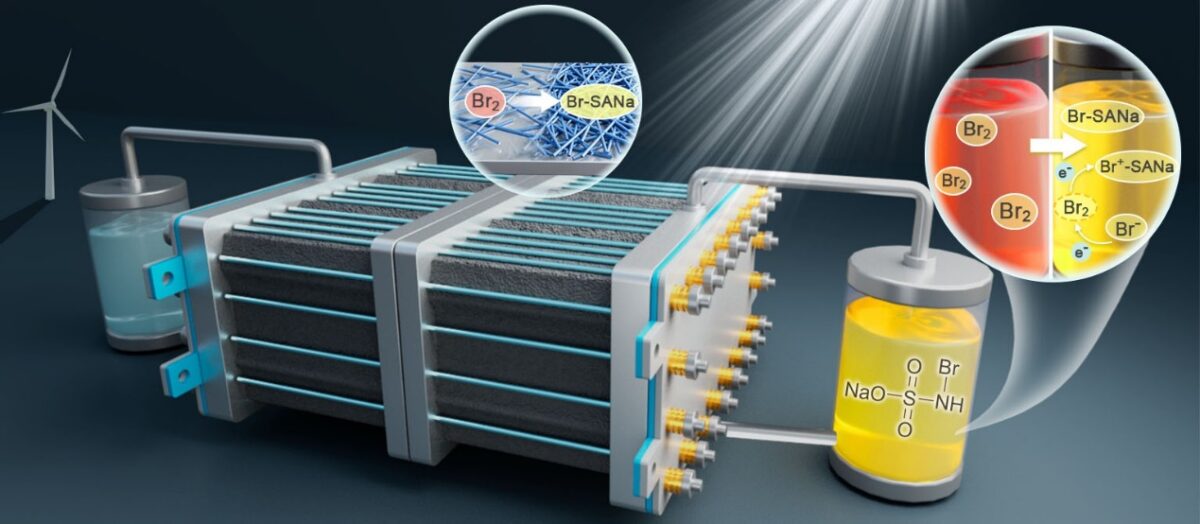
Researchers at Dalian Institute of Chemical Physics (DICP), Chinese Academy of Sciences, have developed a new bromine-based flow battery chemistry that addresses one of the technology’s longest-standing barriers: severe corrosion caused by free bromine during charging. The team reports that the approach simultaneously extends cycle life and lifts energy density, potentially improving the commercial outlook for zinc–bromine (Zn/Br) flow batteries in long-duration energy storage.
Bromine flow batteries are attractive for grid applications because bromine is abundant, highly soluble and offers a high redox potential. In conventional systems, however, the charge reaction converts bromide (Br⁻) to elemental bromine (Br₂). The accumulation of Br₂ leads to aggressive corrosion of electrodes, current collectors and membranes, typically limiting cycle life to a few hundred cycles and forcing the use of costly, corrosion-resistant materials such as fluorinated membranes and titanium components.
To continue reading, please visit our ESS News website.
This content is protected by copyright and may not be reused. If you want to cooperate with us and would like to reuse some of our content, please contact: editors@pv-magazine.com.

By submitting this form you agree to pv magazine using your data for the purposes of publishing your comment.
Your personal data will only be disclosed or otherwise transmitted to third parties for the purposes of spam filtering or if this is necessary for technical maintenance of the website. Any other transfer to third parties will not take place unless this is justified on the basis of applicable data protection regulations or if pv magazine is legally obliged to do so.
You may revoke this consent at any time with effect for the future, in which case your personal data will be deleted immediately. Otherwise, your data will be deleted if pv magazine has processed your request or the purpose of data storage is fulfilled.
Further information on data privacy can be found in our Data Protection Policy.